

Issue 5.13: The SOURCErer's Apprentice
Game Development As the Most Complete Magic You Can Actually Perform [A Metamagical, Ludological, Psychological, and Philosophical Analysis]

Game & Word Volume 5, Issue 16: Sunday, Aug. 16, 2026

Publisher: Jay Rooney
Author, Graphics, Research: Jay Rooney
Logo: Jarnest Media
Table of Contents
Summary & Housekeeping
Feature: “The SOURCErer’s Apprentice” (~104 minute read)
Food for Talk: Discussion Prompts
Further Reading
Game & Word-of-Mouth
Footnotes
Summary:
Welcome back, dear reader.
Wow, it’s been quite a ride, hasn’t it? After nearly three years, we’re finally at the grand finale of Volume 5. We started with a simple question: “Do you believe in magic?”, and then embarked on a veritable tour-de-force through the arcane and mystical side of video games, starting with the long spell that the fantasy genre (and J.R.R. Tolkien specifically) cast on video games, then ascending the Tree of Life with Cloud Strife & Friends, untangling religious orthodoxy and magical heresy in the Lands Between, descending into Hell itself to confront Diablo, and staring down the eldritch face of divinity itself with Zeus, The One Who Waits, and our eternally-tortured Sims by our side. And now, we’ve come full-circle, about to embark on one last magical quest before I give this Volume license to depart and close the ritual.
But before we start, I feel compelled to apologize to you, dear reader... for last time, I callously left you hanging off a cliff.
I’m sure you remember what I’m referring to, but just in case you need a refresher: last time, we’d spent an entire 10,000 word feature dissecting and autopsying the dark arts in video games, covering everything from blood magic and forbidden knowledge to curses and demonic pacts (we basically speedran gaming’s entire cursed catalog!), and we established that the games that properly depict infernal transactions basically always make you pay for them in some way. After all, UNLIMITED POWAHHH should cost blood, or your sanity, or your very selfhood, and quite possibly for all eternity… and so any game that simply hands you necromancy for free (ie, the proverbial and delightfully punny “free lich”) has fundamentally missed the point, entirely.
And then, right at the end, I asked you a question… before I, like some hack TV showrunner ending the season on a cliffhanger, straight-up refused to answer it:
If the game is handing you cost-free power... what does that make the people who built it?
“A question for another day,” I said, twirling my dastardly (but totally dashing) mustache and fiendishly cackling as I vanished in a puff of smoke.
Well, seeker… today is that day.
And don’t worry, I’m not going to make you wait for the answer, either, because you’ve more than earned it at this point. Thirteen main issues and a handful of bonus issues into this volume, over the span of nearly three years, I’ve taken you through the Tarot and Kabbalah alike, putting all the angels and the demons and the demiurges in the gaming canon under the same microscope, dissecting the metaphysics of liches and deities alike while meticulously deconstructing their lore, and all throughout this time you’ve been dutifully tagging along, patiently waiting to see where this was all going, and I teased the payoff so cruelly by asking that question and then leaving you hanging once more, you’ve been tenaciously holding your breath for the big reveal.
Well, my friend, here it is… the answer to that aching question, as big and bright as a full health bar:
Game developers are wizards.
Yup, that’s right. The people who make video games are wizards.
No, don’t you roll your eyes at me. I don’t mean it in that trite and cutesy way that people on LinkedIn say, where you’re apparently a “code wizard” if you know how to center a div, nor do I mean it like your aunt does whenever you fix her Wi-Fi. I mean it quite literally.
Well… sort of. After all, I’m not claiming game devs can shoot actual fireballs from their fingertips; but what I am saying is that if you wrote down the way humanity has described the work that magicians have done for the last ~5,000 years, across every grimoire, mystery cult, and nervously-whispered tradition that would’ve gotten you exiled, excommunicated, or burned at the stake for dabbling in, and then held it up next to any modern game developer’s job description… the two documents would match almost line for line.
The magi of old merely promised to speak worlds into being… whereas the magi of today have built and optimized an entire build pipeline for doing so, repeatedly and at scale.
So, there you have it! The answer you’ve been waiting for, and the heart and soul of this entire Volume. Everything else in this (admittedly massive) issue is basically me proving it to you, in four different senses of the word “magic,” until the only way out would be to argue that magic never meant anything at all.
(Oh, and someone will argue that, by the way. His name is Max Weber; he’s been dead for over a century, and I’ve saved him a seat near the end.)
Anyway, grab your robe and your wizard hat,1 because we’re finally taking this Volume past the finish line!
~Jay
Housekeeping
This issue wraps up Game & Word Volume 5! Once this issue and its accompanying Bonus Quest drop, I’ll take a bit of a break to recoup (save for maybe a few extra Bonus Quests with odds and ends I couldn’t fit into Volume 5, along with some more topical takes if the need arises… but this is far from a given, so don’t hold me to it!) before coming back with the inaugural issue of Volume 6: Pixel Perfect. This upcoming volume will explore beauty, aesthetics, art, and design in video games!
More details to come soon… but in the meantime, per Game & Word tradition, here’s a sneak preview of Volume 6’s header image:
Hopefully, that’s enough to get you excited and curious and what’s coming your way. Again, more details soon. But for now, I must ask you to read on… because it’s time to, at long last, finish off Volume 5 with a blast!
—
Also, ICYMI, I recently launched a sister publication, Spawn Point Marketing, that serves as a companion newsletter to my brand-new games marketing consultancy of the same name.
Subscribe for weekly game marketing tips, analysis, and case studies for indie and AA game developers who need to successfully market and their game in an increasingly crowded marketplace, but lack the expertise to do so or the budget for a full marketing team (oh, and all my industry analysis will live there going forward, so if you enjoy those pieces, subscribe to SPM for those as well; going forward, Game & Word will exclusively be about the games themselves):
I also, through Spawn Point Marketing, offer fractional marketing leadership services to indie and AA game studios. To learn more about the services I offer, or to book a free consultation, visit https://spawnpointmarketing.com or click the button below:
Previous Issues
Game & Word’s most recent issues (currently, all of Volume 5) are available to all, free of charge.
Older issues are currently archived and only accessible to paid subscribers. To access the full archive, upgrade to a paid subscription:
Volume 1 (The Name of the Game): Issue 1 ● Issue 2 ● Issue 3 ● Issue 4
Volume 2 (Yo Ho Ho, It’s a Gamer’s Life for Me): Issue 1 ● Issue 2 ● Issue 3● Bonus 1 ● Issue 4 ● Issue 5 ● Issue 6 ● Issue 7 ● Bonus 2 ● Issue 8 ● Bonus 3
Volume 3 (Game Over Matter): Intro ● Issue 1 ● Issue 2 ● Issue 3 ● Podcast 1 ● Issue 4 ● Video Podcast 1 ● Bonus 1 ● Issue 5 ● Podcast 2 ● Issue 6 ● Issue 7 ● Issue 8 ● Issue 9 ● Podcast 3 ● Bonus 2
Volume 4 (Tempus Ludos): Intro ● Issue 1 ● Video Podcast 1 ● Video Podcast 2 ● Issue 2 ● Issue 3 ● Issue 4 ● Issue 5 ● Podcast 1 ● Issue 6 ● Issue 7 ● Issue 8 ● Issue 9 ● Issue 10
Volume 5 (AbraCODEabra!): Intro ● Issue 1 ● Issue 2 ● Issue 3 ● Issue 4 ● Issue 5 ● Issue 6 ● Issue 7 ● Issue 8 ● Issue 9 ● Issue 10 ● Issue 11
Feature: The SOURCErer’s Apprentice
🚨🚨🚨 SPOILER ALERT 🚨🚨🚨
This piece discusses the structure (and one key monologue) of Christopher Nolan’s The Prestige (2006), plus a handful of famous “whoa” moments from The Legend of Zelda: Breath of the Wild (2017), Shadow of the Colossus (2005), Journey (2012), and Elden Ring (2022).
There’s nothing that ruins the plot for these games (most of these are literal opening-hour reveals), but if you want to experience The Prestige completely cold (and you really should, it’s absolutely fantastic), then maaaybe just bookmark this article and come back later. Don’t worry, it’s not going anywhere.
💡💡💡 POINT OF CLARIFICATION 💡💡💡
Yes, here we go again with my standard Volume 5 clarification, one last time for the road: when I say “magic,” I spell it without the “k.”
I first laid out my reasons back in Issue 5.0 and I’ve repeated them in basically every issue thereafter; my reasons haven’t changed since then, and neither has Aleister Crowley’s inability to stop me.
So whether it’s stage magic, supernatural magic, Jungian psych-magic, or Magic Erasers… for all of it, I just use “magic.” Simple, easy, clean! Don’t worry about getting confused, for context will make it clear which one(s) I mean (and if need be, I’ll spell it out more explicitly).
All that said, over the course of this feature, I’m going to use “magic” in four distinct senses:
The supernatural sense (speaking reality into being as an act of pure will),
The psychological sense (casting a spell over a mind, even if it’s just your own, regardless of whether the mechanism is spiritual or mundane),
The participatory sense (when the apprentice yoinks the wand from the master’s hand and goes HAM),
And the plain, everyday, “how the f$&k did they DO that?!” sense (when the audience gasps at a stage magician’s “impossible” trick).
I’ll be switching back and forth between them a fair amount, and very much on purpose, because this piece’s whole argument is that game development is the only human practice where all four senses stop being metaphors at the same time. So when these four senses blur, pay attention; that’s this article working its literal magic on you.
🚫🚫🚫 DON’T BE A MORAL COSPLAYER 🚫🚫🚫
Finally, this piece uses a few AI images. If you have a problem with that, I REALLY don’t want to hear it; the unsubscribe button is right there, just go ahead and use it if this is that big of a deal to you. No hard feelings, it’s not me it’s you, etc… but if you start sounding off about it, that’s an instant permaban. Moral grandstanding is not welcome here.
Constructive criticism and debate, on the other hand, is always welcome… but when AI is the topic, that always seems to go right out the window. So I’m disallowing it right off the bat; don’t want to deal with it here.
Oh, and this article uses em dashes, semicolons, Oxford commas, triads, negation-affirmation constructions (and other parallel structures), lists, and fancy Latinate words galore (like I have been since I first srarted writing about games back in 2019; check the archive if you don’t believe me). This used to be called “writing well,” and any halfway-literate person knows this. So if you read any of that and think “oOoOh, gOtChA!!! tHiS iS Ai!!!1!!”, then you are not smart enough to read this newsletter (and if you comment as much, that’s also an instant perma). Same if you feel compelled to use that little “scan” button because a sentence sounds slightly more eloquent than the dreck you devour on BuzzFeed or TMZ.
Go away, leave us actual creators alone, and find something better to do with your life (literally anything else) than cosplaying Joseph McCarthy or a Salem judge because your life sucks and you’d rather tear people down than try to build yourself up. I’d tell you to actually try to create something (that people want to engage with) yourself, but something tells me that’s way beyond your reach. Maybe go watch some Cocomelon instead?
(That’s all I’m going to say on this topic. Click here and here to read my full position on AI and the surrounding witch hunt “discourse,” if for some reason you feel so inclined.)
Any Sufficiently Advanced Magic Ships With a EULA
“Any sufficiently advanced technology is indistinguishable from magic.”
~Arthur C. Clarke
“I create as I speak.”
~An old magic word (Possibly… but don’t worry, we’ll get there)
Before we light our candles and draw our magic circles, I’m going to start us off by flipping the argument I advanced all the way back in Issue 5.0, at the very start of this Volume. To recap:
At the start of Issue 5.0, we established that magic is a technology. Every magical tradition in history is, at its core, a technique — in this context, a method for systematically shaping reality according to your will.
But the inverse is also true: if magic is a technology, then technology is also a magic. Specifically, any technology that actually does what a magical tradition has promised to do is that tradition, in its fully realized form. Note: not merely “like” or “resembling” it, but fully IT, period.
ERGO…
If we take as true both that magic is technology, and that technology is magic, then (as I will spend the next 20,000 words proving to you) game development is the most complete form of magic that any human being can currently perform, because it is the only practice on Earth that actually does what every major magical tradition in history merely promised… and it does so day in and day out, through the hands of legions of literal, salaried, and IRL magi.
Don’t believe me? Fine. Let’s spell it out all out, shall we? (Pun obviously intended).
Here’s what every single one of humanity’s magicians, starting with Ancient Egyptian priests and running through to Medieval Kabbalists, Renaissance magi, and all the ceremonial lodge members in their silly hats (with all the voodoo shamans and village “cunning folk” thrown in for good measure), have actually claimed they could do, according five millennia’s worth of tomes, scrolls, grimoires, and folk tales:
Speak worlds into being. If you say the right words, and say them in the right order, then reality itself will reorganize to match them.
Name matter into obedience. If you learn a thing’s true name, then that thing is compelled to answer when called and obey your every command.
Bind spirits to rules. Oh yeah, speaking of which… in that same vein, you can summon entities, bind them however you see fit, and put them to work.
Cast a spell over other minds. You can also induce visions and trances in other people, making them feel what isn’t actually there (…or is it?).
Manufacture wonder. Finally, you can do the impossible before actual eyewitnesses, and have your ego harvest their sweet, sweet gasps.
Now, take a look at that list again… and tell me that isn’t any given game developer’s ordinary Thursday. To whit, every single game dev:
Speaks worlds into being… in a programming language.
Names matter into obedience… by declaring variables and defining classes.
Binds spirits to rules… by writing the AI routines that govern what every NPC can and can’t do.
Casts a spell over minds… specifically, yours — every time you lose four hours immersed in a good game and finally come up for air at 2 AM, wondering where the hell your evening went, guess what? You’ve been under a spell that entire time!
Manufactures wonder… specifically, mass-produced wonder, on a budget and a schedule, on an industrial scale, with even a marketing department that then distributes the gasps to millions worldwide.
As above, so below. Every item on the magus’ résumé has now been fully realized, systematized, optimized, and shipped... to the tune of over 20,000 times each year.
So, let’s take a deeper peek under the hood shall we? We’re going to examine that job description, one by one, across a series of four “Acts”:
Starting with Creation,
Then moving onto Enchantment,
And finally wrapping up with Wonder,
Along with a brief stop in between to hand the wand to a certain apprentice (that’s you, player).
But before we can talk about developers speaking worlds into being, we do need to establish some groundwork… in the form of that very concept’s origin story, which happens to also be at the root of every religion, every art form, and (I’d argue) every game engine since id Tech 1.
We need to talk about where magic started.
Creation Was the OG Spell

Here’s a fun little exercise to get you warmed up: go ahead and pull up any creation myth. Like, just go ahead and pick one at random; yes, any one, from any culture, in any continent, and from any millennium. Then ask one — and only one — question of it:
How does all this “creating” actually get done?
No, not who does the creating… the “who” can be practically anyone or anything, depending on who’s telling the story, from gods and titans to cosmic eggs and even primordial cows (you can thank Norse mythology for that one). In any case, it’s not particularly relevant here.
Ask HOW... as in, what is the actual process by which “nothing” becomes “something”?
Uncannily often, and maybe even most of the time (I admittedly haven’t run the full tally; feel free to let me know in the comments if you decide to take up the task), the answer is: because somebody says something.
Let’s start with the most obvious example, the cosmogony that most of my readers either grew up with or within shouting distance from: Genesis 1. What, do I really need to spell it out for you? Sigh… ok, here goes:
In the beginning, the universe was a formless void, literally nothing but endless darkness upon the endless expanse of the deep… and then, God spoke: “Let there be light.” And that, right there, is the key to the puzzle. You probably slid right past it in Sunday School, but as an adult, it should stop you cold in your tracks: the utterance is, in and of itself, the engine of creation.
In other words, God doesn’t just say “let there be light” and then go and build light. He’s not running a divine workshop here, holding heavenly sprint meetings each week. There’s no assembly period, and He’s not instituting mandatory cosmic crunch time. His saying it IS Him making it, in and of itself; speech and creation are a single, indivisible act.
Or to put it more simply: to speak IS to create.
In the beginning, there was the Word… and the Word gave form to literally everything else.
And lest you think this is a random quirk of just one ancient Levantine tradition (albeit a highly influential one), I’ll have you know that the Egyptians got there first, and they arguably laid it all out even more explicitly! The Memphite Priests, who preserved their theology on the Shabaka Stone (a big slab of basalt currently sitting in the British Museum) but claimed it was passed down to them by far older sources that have since been lost to the sands of time, believed the god Ptah created the entire world with his heart and his tongue.
You see, in Egyptian thought, the “heart” was the seat of thought and the “tongue” was (obviously) the instrument of speech; so Ptah first conceives the world as an idea, then pronounces it into existence. Every god, every creature, every person, and indeed every thing in existence was first thought, then spoken, then suddenly was “real.”
The Shabaka Stone is, and I say this completely unironically, a design document for Ptah’s implementation (ie, development) period of the world’s creation. Thousands of years before anyone ever coined the term “waterfall development,” the priests of Memphis had carved it into literal stone.2
And before you tell me that this is just a Western/Near-Eastern thing, let’s cross over to India real quick, where the Vedic tradition literally personified this very pattern. In the Rigveda, one of humanity’s oldest religious texts, Speech itself is a goddess: specifically, the goddess Vāc. And in Rigveda 10.125, the famous Devī Sūkta hymn, Vāc speaks in the first person and quite clearly explains her role in the cosmos: she courses through all beings, and in doing so she sustains even the gods themselves. So in addition to creating the universe, speech is also one of the universe’s most fundamental forces, like gravity or electromagnetism is to our more secular minds (or the Force within the Star Wars universe). Speech is, indeed, the very medium through which divine reality is able to express itself at all, which is quite beautiful and poetic if you think about it!
But for now, let’s circle back to Judaism; specifically, the Jewish mystical tradition, which took the basic concept that Genesis laid out (“In the beginning, God spoke everything into existence”), asked the single most engineer-brained follow-up question in all of religious history, and then answered it with all the gusto of a savant Redditor expounding on quantum bioevolutionary neopsychology. The question was:
Okay, sure… but which character encoding did He use?
You can find the answer, developed through centuries of mystical back-and-forth, in the Sefer Yetzirah: the “Book of Formation,” one of the foundational texts of what would become eventually become Kabbalah. It describes God creating the universe through the 22 letters of the Hebrew alphabet: carving the m, weighing them, then permuting and combining them into literally all of existence.
Reality, as it turns out, is just a very, very, very large string!
I’ll stop there on Kabbalah, because as the old-school Game & Word readers know, we spent two entire issues (specifically, Issues 5.2 and 5.3) ascending the Tree of Life through the lens of Final Fantasy VII, along with an extra side trip with Balatro as our tour guide in Issue 5.9, so I hope you’ll forgive me if I’m not really in the mood to retread lore we’ve already cleared. So go read those, if you haven’t already (you might want to grab a cuppa first, as it’s all quite in-depth).
In any case, my point stands: in the Jewish esoteric imagination, the alphabet is the universe’s source code, and really, I could not have invented a better setup for this article if I’d planted it myself two years ago.3
So, to recap: we’ve just explored Genesis, Memphis, the Vedas, and Kabbalah. These four traditions, wildly separated in both geography and theology, all converge on the same fundamental claim: creation is an act of speech. The first thing that ever happened, happened because the right words were said (who said them is not as important in this context; what matters is the simple fact that the words were said at all).
Which leads us to the foundational claim that this entire article (and indeed this whole volume) rests on, something our species has been saying about itself for a very, very long time:
Every creative act is, in essence, a faint echo of “let there be light” (or water, or fire, or hedgehogs, or whatever).
Tell me, what’s actually going on, beneath the surface, when a sculptor pulls a figure out of a marble block?
How about when a novelist fills 300 pages with a living, breathing world filled with living, breathing people who eat, sleep, walk, and speak, just like she does? Does that resemble anything we’ve just read about?
Ok then, well have you ever seen a kid stack a bunch of cushions, drape a bedsheet over them, and triumphantly declare that the whole thing is a fortress and HA HA, just try to march in and haul me off to bed now?
Stumped? Give up? Ok then, I’ll tell you what’s going on:
Each and every one of these creators is re-enacting the original divine act of creation.
Why do we make things? Because we were made! Specifically, we were made in the Maker’s image, so of course we were going to try and make things of our own! And us being in the Maker’s image, it makes sense that the way we make things would be the same way He made us, right?
I’m probably not the first person you’ve heard this from, because it’s practically archetypal. Seriously, this idea shows up everywhere, from
Renaissance humanism to Romantic poetry… but nobody (and I really do mean
nobody) articulated it better than a certain Oxford philologist whom you may
remember from the earliest days of this Volume.
The Professor Returns

Way back in Issue 5.1, when we traced how J.R.R. Tolkien cast his (very) long spell over the fantasy genre and subsequently all of gaming, I briefly mentioned a concept from his 1947 essay “On Fairy-Stories” and promised we’d come back to it.4 That concept is called sub-creation, and I’d say it’s about time that I properly dissect it for you… hey, what’s with that look? Better late than never, right?
Anyway…
*takes deep breath*
Tolkien’s argument is as follows (albeit highly compressed; it’s necessary, so please spare me your wrath, Tolkien stans): people make fantasy worlds not as escapism or to lie, but to exercise our very deepest nature (remember, we are made in the image of a Maker… therefore, we make). He called the fantasy author a sub-creator, and he called the world she builds a Secondary World, to distinguish it from the Primary World we all have to wake up in and pay rent.
And here a nice little twist, which not only makes me admire the man all the more, but which I’d also love the entire fields of game studies and literary/film criticism to repeat to itself until its permanently seared into its synapses: Tolkien utterly despised the phrase “willing suspension of disbelief.” He thought it described a failure, not success.
After all, when you’re immersed in a good story ( like really lost in it), you don’t have to laboriously “suspend” anything. Instead, you extend to that story’s Secondary World what Tolkien called Secondary Belief: while you’re inside it, everything that happens in the world is true, according to its own laws. While you’re within the author’s frame, you fully and genuinely believe this, and you do so entirely without any effort on your part. The moment you have to consciously suspend your disbelief, the spell has already shattered, and from that point on you’re just being polite to the author.
The sub-creator, in other words, doesn’t ask your imagination for a favor. A good sub-creator commands your imagination, by building a world so internally consistent and coherent on its own terms that it’s actually easier to believe when you’re inside it!
Now... Tolkien was writing about “fairy-stories” (gotta love that old-timey academic vocab!) and whatever else you could say about the man (besides him being a genius and visionary), he certainly walked the walk: he created arguably the most fully realized Secondary World (Middle-earth) to ever grace the page (and eventually, multiple types of screen).
I mean, come on… is it even close? Middle-earth has MULTIPLE fully developed fictional languages, each with their own grammar and proper synthax. His works also exhaustively catalogue the realm’s complex genealogies, dutifully climbing their myriad meandering and branching trees. Hell, he even crafted a full-fledged cosmology for Middle-earth, with a creation myth of its own — naturally, the world was created by speaking words… well, more specifically, a song: the Ainulindalë, wherein the world is literally sung into being. Clearly, the man knew which tradition he was working in!
But Middle-earth has one fatal flaw that Tolkien couldn’t sub-create his way around, and that same flaw also hampers every Secondary World ever committed to a page, canvas, or film reel:
It does not move.
Middle-earth is magnificent, yes… but it’s also static. The reader can visit the world, but she cannot act within it. Every time you read The Lord of the Rings, Frodo will take the Ring to Mordor, and he will do so whether you cheer him on or weep along the way; no matter how ardently and sincerely you believe in the world Tolkien has created, that belief can and will change absolutely nothing within it. The maker has already spoken; as such, the world as it was first spoken is already complete. Tolkien’s entire magnificent Secondary World, from the rolling hills of the Shire to the White Mountains of Gondor, is like a majestic cathedral that you can walk through as much as you want, and peek into its every nook and cranny, but can never renovate. You’re like a ghost wandering the halls of Edoras, helpless to do anything to break Grima Wormtongue’s spell over Théoden until Gandalf and Aragon finally set things right.
Every sub-creator, from 2100 BCE through around 1960 invariably hit this same wall. Until a new kind of sub-creator showed up, working in an entirely new kind of language…
…and then, the wall came down.
ACT I — Creation: The Word That Makes Worlds
Now, let’s go back to the game developer’s job description. We’re going talk about what a game developer actually does, stripped of all the industry jargon, down to its very essence.
Every day on the job, our humble game developer sits down at a keyboard and writes sentences in a formal language. If the sentences are correct (and like, perfectly correct, down to the last character), an entire world comes into existence and, most importantly, it runs.
Read: it’s dynamic. It’s alive. It has its own physics, its own weather, and its own caderie of people and creatures who wake up, patrol, react to the things around them, and eventually die. It has its own laws, and these laws hold because they’re made of the same stuff that the world is.
If the developer mutters an incorrect sentence (even if just by one character, such as a single misplaced semicolon), then the world either refuses to exist at all, or exists briefly and then collapses into a stack trace: the smoking crater where an entire cosmos used to be, annotated with the exact line where the utterance went wrong.
Stop for a moment to think about how utterly remarkable that very fact is! I understand if you need to sit with it for a bit, because familiarity has completely numbed us to how magnificently insane it all is. This is the Book of Genesis’ engine of creation! This is Ptah’s heart and tongue, speaking the world into being. Saying is making; in game development, as in all creation, there is no gap between the utterance and its effect. A programming language is performative, all the way down — instead of merely describing a world that exists somewhere else, it becomes a world via the very act of correctly expressing it. Say it right, and it happens. Say it wrong, and nothing happens (or the wrong thing happens, which as any demonologist will tell you, is considerably worse).
For over 5,000 years, magicians claimed to know and speak this exact kind of language, but the historical evidence that any of their languages actually worked is…. shall we say, mixed.5 But then, in the middle of the 20th Century, we actually built one. Actually, we built several. And as if the very fact of these languages’ creation wasn’t crazy enough, I’m going to further blow your mind right now with a tiny little detail that will not only inexorably persuade you of my thesis’ validity (and only a couple thousand words in, a new record!), but also level up this cute little analogy into a full-blown cultural revelation that any enterprising game scholar could probably write a hundred dissertations on (any PhD candidates in my audience, take note… and you’re welcome).
To see it, just look at what we named everything:
A programmer calls a function; he summons it by name, and lo and behold, it comes!
He instantiates objects, speaking an abstract Form into a concrete particular (Plato, anyone?).
He spawns entities and kills processes.
He invokes methods… invokes! You know, the exact verb that the English language reserves for calling upon gods and spirits.
He binds variables, the same way a summoner binds a demon to a name and a circle.
And when he’s written a set of procedures that reliably works when properly recited? He stores them in (and I swear I’m not making this up, this is the actual industry standard term) a library.
A library… you know, the kind of place where you’d keep a book of tested formulas, passed between practitioners, that does things when you read it correctly.
We have a word for that book already. In fact, we’ve had it for centuries!
It’s called a grimoire.
None of this vocabulary was imposed by mystics, mind you. Mid-century engineers, aka the most aggressively rational humans of their era, organically and unselfconsciously chose it because it was simply the most accurate vocabulary available!
So the world’s first computer engineers reached for the magician’s lexicon for the same reason you reach for a hammer when you see a nail: it fit, and it got the job done. As it turns out, if you need to describe when uttering a name causes whatever’s been named to appear and obey, natural language offers only one register: the occult one.
Erik Davis (whose seminal tome TechGnosis (1998) we also first cited back in Issue 5.1, so consider this a continuity rather than a new summons) wrote a whole book around this observation. According to Davis, mystical ideas and imagery never actually left Western culture… they just migrated into our information technology, smuggled inside all the occult metaphors.
Since time immemorial, humanity has dreamt of uttering the perfect language, the word of power that could bend reality to one’s will, the animated servant that would unquestioningly do our every bidding, the realm of pure spirit accessible through the right rituals… and all of it survived contact with the Enlightenment, simply by swapping its wizard robes for a hoodie and getting a job in the tech sector.
True Names (Now With Type Safety!)
Out of all the smuggled magical doctrines we introduced above, there’s one in particular that made the crossing to modernity most unscathed: what folklorists call the Law of the True Name, the idea that to know a thing’s real name is to hold power over it.
This law appears everywhere throughout our collective storytelling and mythology. It’s why Rumpelstiltskin loses everything the moment the queen speaks his name, for instance. It’s also why, in magical and religious traditions everywhere from Ancient Egypt to Medieval Europe, priests and kings throughout history guarded the true names of gods and demons alike as if they were weapons — because if you knew the names, you could weaponize them (for example, Isis gained power over Ra himself by tricking him into revealing his hidden name). Likewise, exorcists demand to know a demon’s name becuase they need to know it before they can cast it out. And on a more quotidian level, in many cultures a person would keep their “real” name secret, using only a “street name” while out in the world so that nothing out there could latch onto it (speaking of actual “street names,” this is also the reason those even exist, albeit in a more materially grounded variation: the law can’t track you down if it doesn’t know who you are!). We often think of a name as a label, but at least according to mystics, the name is more like a handle on a puppet string: if you speak it, the thing that you call must respond.
Now, watch as a programmer declares a variable:
She writes a name (let’s say, playerHealth) and in that very moment, she sets aside a portion of reality (a very small and very rectangular reality, but a reality all the same) that answers to that name, and only to that name. Forever after, within the world that she’s building, whenever she calls the thing that she named, LO AND BEHOLD! The thing comes (and instantly, at that!). And it OBEYS, dutifully carrying out whichever task she assigns it: when she says “read,” it coughs up the value its holding (playerHealth = 100); when she says “write,” it ditches that value and swaps out that value for whatever she told it to hold instead (now, playerHealth = 83 after the player character suffers a critical hit). No matter what, the thing cannot refuse the call, it cannot lie about what it is, it cannot do what it was not told to, and it cannot answer to another name.6 The Queen first figured it out with Rumpelstiltskin, and now, we’ve figured it out ones and zeroes!
In this light, you could say the entire discipline of programming is a form of applied onomancy: name magic, only performed by a compiler instead of a warlock. And the compiler is a far stricter ritual master than any warlock who ever lived… which brings us to all the ways that this can go wrong.
The Guttering Semicolon
Every magical tradition worth its salt (pun intended… iykyk) is absolutely obsessed with precision. The working calls for a perfect, unbroken circle… and why yes, you also have to flawlessly trace all of the sigil’s squiggly lines, why do you ask? Oh, and don’t forget to pronounce the complete incantation correctly, and in the right order… yes, even the ten Latin verses. Remember, the Weave doesn’t grade on a curve! If you botch just one syllable, you won’t get 95% of a demon — you get nothing.
…Or you get something else, something u̴͓̻̙͚̘͔̐ṇ̶̭͖̮̞̻̎͋f̴̧͔͆̑̚ä̵̛͉̩͖́͊̿͝ṭ̵̱̱̞͇͛͒h̷̢̝̠̅̈o̸͉̮͝͠m̷̦̫̩̀̓͛ä̴̛̟͓̟̭͓̕b̸̨̛̪͈͔̠̾̋͗͘l̴̞͔̼̳̥͊̽͜ę̸͇̮̟͍͊̏̓̑ that came through the gap that your careless error left open.
Ceremonial magic is notoriously fussy about detail, but it’s not being pedantic for its own sake. There’s a reason they’re so fussy — remember, these people quite literally and quite earnestly believe that words are powerful enough to literally act upon the world. When you put it that way, their fussiness actually seems quite reasonable!
Oh, and software engineers also believe that words can act upon the world… although theirs is a virtual world, of the kind that exists on a motherboard. But still, is that really much of a distinction? After all, this “virtual” world can very much affect the “real” world — remember when that airport software glitch stranded millions of travelers all around the world? Or, for that matter, how does your day change if your Google Calendar ever goes down? Really, it’s no wonder that software developers converged on the same fussiness as the ceremonial mages did!
Whenever a missing semicolon fails an entire build, it’s basically the same as when guttering candle breaks a magic circle. Really, is a dev squinting at her screen at midnight while she triple-checks a regex one character at a time at all that different than a medieval necromancer who also once triple-checked his sigils, trace by trace, in a dark candlelit room of his own (also at midnight, naturally… ie, the witching hour). If either mess up even the single smallest and most insignificant detail, they can unravel the entire working.
Both practitioners know this, to the point of reflex. They both have war stories about this happening, and as such they’ve each developed, completely independently of each other, highly elaborate verification rituals (compare a code review to a second robed figure double-checking the chalk lines, and tell me I’m wrong)… because they both know that the cost of a flawed utterance is (at the very least) a world that dies on first contact with reality.
The difference — really, the only meaningful (read: non-superficial) difference7 — is that only one of their languages compiles.
📜💬✨ SIDE QUEST: I Speak, Therefore I Am
It’s finally time to bring in some actual academic rigor, because so far I’ve mostly been arguing through words and vibes, and you deserve a real philosophical backbone to prop all of this up. Well, here you go! His name is J.L. Austin, and he’s quite possibly the most important philosopher you’ve never heard of.
In a series of Harvard lectures published as How to Do Things with Words (1962), Austin blew up one of philosophy’s laziest longstanding assumptions: that a sentence’s job is to merely describe the world, and that every sentence is therefore either true or false. Nonsense, said Austin (in a quite impeccably donnish way, I’m sure). Whole categories of sentences don’t describe anything... instead, they do things.
He called them performative utterances. To illustrate, consider the following sentences:
“I now pronounce you married.”
“I christen this ship the Queen Elizabeth.”
“I bet you five dollars.”
“You’re fired.”
None of these sentences merely reports an event… each one IS the event. Before the officiant speaks, the couple isn’t married; after, they are. What changed? Well, the speaking itself exacted the change! You can’t fact check “I now pronounce you married” as either true or false; you can only ask whether it worked, whether the conditions were right (Austin delightfully called these “felicity conditions”, and they consist of the right speaker, the right context, and the right form) for the utterance to take effect. If the wrong speaker says them? Or if the right speaker says them at the wrong place or at the wrong time? Or if the right speaker at the right place says them the wrong way? The spell fizzles. The words may have been said, but nothing was actually done.
(Hey, I just noticed something… take a look at those last two words I italicized. “When it’s all said and done,” anyone???)
Speaker… context... exact form... “effective or not” rather than “true or false”… if your grimoire senses are tingling, they should be: Austin accidentally wrote basically every incantation in history’s instruction manual.
Think about it: what is a magic spell, if not an attempted performative? When a magician utters a spell, he’s literally attempting to create his own reality! And for the spell to succeed, the right speaker (the initiate) needs to speak it in the right context (within the circle, at the the hour, during a certain phase of the moon, etc.), and in the right form (he needs to recite the exact syllables, and recite them in the correct order, or it doesn’t count). Every magic word anyone has ever intoned, starting with fiat lux and carrying on through the present day, is an attempt at what Austin identified: language that does something instead of merely telling us of it.
But alas, the tragedy of historical magic is such: natural language makes for a lousy performative medium. Outside a handful of social rituals (such as weddings, christenings, and contracts), words really do simply... describe things. The universe just doesn’t hold up its end of the bargain! You can flawlessly pronounce a mountain hereby moved, with all your heart and with all the magic words, and the mountain will simply… stay put (wipe that stupid grin off your face, you stubborn mountain).
But then we built code: the first truly performative language in all of history. In programming, every statement (provided you’ve typed it correctly) is a performative! Code doesn’t describe; indeed, there is nothing to describe, because the world doesn’t exist until the code utters it. DELETE FROM users doesn’t describe something that happens in the database; the command directly does that thing in the database! And so, for the same reason all the old grimoires constantly warned practitioners not to carelessly say the magic words, so too do exhasperated systems admins everywhereb (and the equally exhasperated documentation they write) implore junior developers to never run that command without also adding a WHERE clause.
Even Austin’s felicity conditions survive the Great Translation fully intact: again, the right speaker (an authenticated/authorized user) needs to speak the words in the right context (the right environment — production and staging environments constitute two different types of ritual space, and woe be to any developer who mixes them up, for he has committed one of the tech industry’s worst transgressions. It’s the closest thing Silicon Valley has to a cardinal sin), and speak them in the exact form (you must nail every last character of the programming syntax, lest the compiler gate your utterance like Gandalf did the Balrog).
Philosophers have spent the last 60 years refining Austin’s framework for our institutions. But meanwhile, the world’s GigaChad engineers one-upped them by (quite serendipitously) building a universe that’s literally made of his framework. And as a result, we can now neatly summarize the entire history of magic words, in just three stages:
Theorized (c. 3000 BCE)
Formalized (1962 CE)
Shipped (shortly thereafter)
Speaking of Animated Servants...
Before we move on to Act II, there’s just one more piece that I need to lay in place: it involves the single most famous story about artificial beings in all of Western folklore.
And really, if you thought I was going to write an entire 20,000+ word feature about creating through language and not bring in the Golem… well, then you must be new here. Welcome! The exits are clearly marked, though nobody (to my knowledge) has ever used them, despite my best efforts.
Anyway! Let us proceed:
🪄🤖💥 SIDE QUEST: newServant(“emet”) = TRUE
Just about every gamer or fantasy nerd (there is a ton of overlap, as we’ve previously explored) knows what a Golem is, but have you ever wondered where it came from? Well, don’t fret, dear reader! I’ll tell you right now.
The story, as it’s usually told, goes something like this: in 16th Century Prague, the great Rabbi Judah Loew ben Bezalel (the Maharal of Prague, a towering real historical figure within Jewish scholarship) shaped a man of clay from the banks of the Vltava and brought it to life to protect the Jewish ghetto from ongoing pogroms. The way in which the golem was brought to life varies somewhat depending on who you ask, but the most famous version is also, fortunately, the most deliciously simple one: the Rabbi inscribes a single word on the Golem’s forehead — אמת (emet, “truth”) — and the clay rises and obeys.
And the way you deactivate the animation is even simpler! To stop the Golem, you simply erase one letter: the aleph. אמת (emet, truth) becomes מת (met, dead). The Golem then crumbles back into inert clay.
I do need to lay out an important disclaimer before we go further; as my longtime readers are well aware by now, this newsletter cites folklore as folklore qua folklore. As undeniably awesome as it would be, the association of the Golem legend with Rabbi Loew is, unfortunately, just 16th Century legend, not 16th Century fact. Now, the Maharal himself was a real person who actually lived and can be verified through the historical record; but his animated clay bodyguard, on the other hand, was basically retrofitted onto him by later storytellers, with the Prague version specifically crystallizing in print only in the late 19th and early 20th Centuries (most famously via Yudl Rosenberg’s 1909 collection, which in the great tradition of pseudepigraphae presented itself as an old manuscript and was, shall we say, a bit creative about that claim). But Golem traditions themselves go back much longer; in fact, we first see instructions for animating figures by inscribing magical letters all the way back in medieval commentaries on the Sefer Yetzirah (that same text that we touched on earlier… you know, the one that gave us the idea that the alphabet is the source code for all of creation?). So the Golem’s emet/met encoding is a very deep and very old metaphysical mechanism indeed… whereas the Prague setting, on the other hand, is basically historical fanfiction. Wonderful and riveting fanfiction, don’t get me wrong! But fanfiction nonetheless. And it’s important to keep that in mind.
Now, with all that out of the way, I want you to put your engineer goggles on and take a closer, deeper look at this legend’s subtext, at what it describes between the lines:
Basically, a human magus animates inert substrate (clay) by inscribing a string (emet); this entity’s entire operational existence depends on that string remaining intact. And so the magus terminates the spell (ie, kills the process) not by reinscribing another string, or by casting a counter-spell, but by deleting a single character, which transforms the string into a different valid token… specifically, one with much deadlier semantics.
Now, compare this magical instance to its programming analogue:
Magus: truth → dead
Programmer: running → segfault
That, my friends, is what we call instantiation. The Golem is newServant("emet"), and its destruction may well constitute literary history’s most famous single-character diff. Every developer who’s ever watched a production system die in real-time because some idiot deleted one character from a config file has actually lived the Golem story, from the Rabbi’s perspective. (And, similarly, every post-mortem meeting since the Golem disintegrated has ended with the same moral as the folklore: the power to animate through inscription is also the power to annihilate through typo, so anyone wielding the former had better respect the latter!)
The medieval Kabbalists who wrote animation instructions in the margins of the Sefer Yetzirah truly believed that letters, correctly arranged, could quicken dead matter. They may have been wrong about the clay, but they were absolutely right about the letters… they were just eight centuries too early, and the clay turned out to be silicon instead.
So, there you have it… we’ve now fully covered the supernatural sense of magic, and its mechanical underpinnings: we’ve seen how we’ve created a truly performative language, learned how true names work, created our very own bound servants, compiled our own grimoires, and shivered at the working’s terrible sensitivity to a single flawed or out-of-place character. The developer speaks, and lo, a world exists… she’s not merely describing, or even depicting, a world, but creating a fully-realized and running world, with laws that hold because they’re made of the same utterance as everything else in said world.
Middle-earth, remember, was magnificent… yet inert. But the game developer’s Secondary World, by contrast, runs. That fact alone would make her the most complete and accomplished sub-creator in history.
But then, she does something Tolkien never even dreamed of:
She lets you in.
ACT II — Enchantment: The Spell on the Audience

Let me ask you a personal question:
Have you ever cried over someone who doesn’t exist?
No, don’t deflect, and don’t rationalize it, either; don’t start typing “b-b-but… it was just so well-written!” at me. I will cast no judgment or aspersions on you, so rest easy — this is a safe article! All I want is for you to search, locate, and actually sit with the memory, no matter how uncomfortable or weird it may feel… and if you’ve been gaming for any meaningful length of time, you absolutely have at least one. Maybe a certain companion who sacrificed herself to save the world comes to mind? Or perhaps it was a farewell or reunion at the end of a +100-hour journey that brought on the waterworks instead?
You see, I know — and I know this for a fact, enough to bet money on it — that at least one time, late at night on a random Tuesday, you defeated a boss and were you’d barely even finished tallying your XP when out of nowhere, a big, long sword sliced through your favorite character. And as soon as you realized that all the potions and revive spells in the game world would not bring her back to life, your brain started pumping all the stress hormones it could muster while draining all the happy chemicals from your body. You sat there speechless, your eyes watering and your controller going slack in your hands… all for what’s basically just a bunch of polygons and voice lines that have been spliced together on a screen.
Whatever the specific details of what happened were (I may have mixed up a few things, but that’s neither here nor there), the crux remains: a pattern of light and sound leaped across the chasm between your TV and your couch, passed through your pupils, and made you feel grief… the same type of grief you feel for a friend or pet. Was it “real”? Not in the sense that the character you’re grieving was real… but in that moment, the tears pouring out of your eyes were certainly “real,” as real as the cortisol that coursed through your synapses. And so were your memories of that character; in fact, I reckon you can recall that character’s death more vividly than most things that actually happened to you that year, much in the same way that you’ve absolutely developed actual, genuine skills in places that were never, technically speaking, really “there” (for example, I could navigate Stormveil Castle blindfolded, and Stormveil Castle has never actually existed).
Behold, the psychological aspect of magic: the enchantment and glamour of it all. An enchantment, by the way, is a spell cast over a mind; I chose that terminology very deliberately.
Out of all the four senses/aspects of magic in this essay, this one’s particularly significant, because it’s the only one we can actually empirically verify.
Think about it. We don’t know, and indeed we cannot know, whether a summoning circle has ever once actually worked in all of human history. The supernatural aspects of magic are, by their very nature, quite empirically slippery; that is indeed the entire point!
But what about magic in a psychological sense? Well, that’s a different grimoire altogether! Indeed, we both know for an absolute fact that a video game (if not several) has, at some point, literally rewritten your emotional state, implanted memories of events that never happened, and trained your reflexes for situations that don’t exist.
Yes, it has happened to you… of this, I am irrefutably certain. Hell, it probably happened to you this week! There are millions such documented cases, all fully reproducible, and you don’t need faith to see that with your own two eyes (the third eye is fully optional here). And if you’re skeptical that this aspect counts as “magic” at all, consider what would’ve happened to a 17th Century witch had she been credibly accused of doing to a villager what Final Fantasy VII did to you. They’d have burned her at the stake! Probably twice, just to be sure.
So, how does this particular spell work? Well, I’ll tell you right now, it’s not the way all the moral panickers have always assumed.
Honey, I Cast a Trance On Myself!
Immersion is a funny thing; practically every gamer who’s earned the label would agree that it’s one of the key hallmarks of any good game. Many players actively seek it out in the games they play, and likewise game developers usually aim to bake it into the games they make. And yet the same qualities that make immersion so compelling to gamers (that truly magical feeling of losing yourself in a whole other world, if only for a few hours) are the same ones that made it so frightening to every moral crusader that’s ever placed our beloved hobby in their crosshairs.
But there is a lazy way to think of immersion, and it just so happens to be the one implied and invoked by every op-ed screeching about how “vIdEo gAmEs aRe hYpNoTiZiNg oUr cHiLdReN” since 1982. This simplistic mental model treats it as something that’s done to you: in this view, the game is a sorcerer firing a beam of concentrated enchantment from a screen into its victim’s the player’s passive skull.
Obviously, that model is wrong, and it’s wrong in both a material and a spiritual/theological sense… because while immersion is a spell, it’s one that you help cast on yourself.
After all, you know the dragon you’re slaying is just a texture. You know this completely, with every one of your brain cells, throughout each frame that it appears on screen! There is no point during any playthrough in which you factually believe that you are in Hyrule; you can hear the dishwasher and feel your couch as you mow through a pack of Bokoblins.
And yet, you agree to believe anyway, because if you don’t believe, the enchantment won’t take. So you step into the developer’s world, pouring all your excitement, fear, frustration, determination, and elation into the magic circle, you agree to be bound by the game’s laws and accept its stakes as real. That is, indeed, the price of entry for the experience you bought the game for!
And right at this moment, Tolkien’s Secondary Belief gets a major buff. Whereas other stories are akin to spectator sports, a game invites you, the believer, to actively collaborate with the creator. When you read a novel, you believe in the world the author made, but when you play a game, you believe in a world that wouldn’t be complete with you in it; indeed, can you think of any other medium where the audience plays such a vital role in creating (not just experiencing) the experience? A game without a player is, quite simply, not a game.
So no, the moralistic Karens who frightened your parents into unplugging your GameCube were wrong. You are not the mark of this magic trick, dear reader… you are a conspirator in it. The developer may have traced the circle with chalk (and Unity), but you willingly stepped inside and held his hands; and for however long you’re under the game’s spell, your mind merges with the developer’s as she guides you in this dance. Unlike most enchantments, you’re fully aware that this is happening, and you can power off the console at any time… but you don’t. You want this. You love it. This trance is a duet.
And make no mistake, you’re in a literal trance. Consider the phenomenon of deep play, which is simply another instance of what psychologists, starting with Mihaly Csikszentmihalyi back in the 70s, call flow: a type of alterered state of consciousness where your attention narrows to whatever it is you’re doing at that very moment.
When you enter a state of flow, your very sense of self dissolves. Time dilates and warps, to where four hours feel like 40 minutes. Action and awareness merge, such that you become one with the game; as you lock in, you immerse yourself into the game more and more until the controller disappears from your hands and you, not the player character, are the one moving through the world.
Literally every gamer has experienced what I’m talking about.
Now, go read any ethnography of trance states and compare it to what I described above. Whether it’s an ecstatic ritual or a drumming ceremony, the hallmarks are identical throughout. In a state of contemplative absorption, the participant’s:
Attention narrows,
Sense of self dissolves,
Experience of time is warped,
Actions and awareness merge until they become one and the same.
This is literally the same list! Whatever else games are (and they are a lot of other things), the’re unquestionably the most widely practiced technology for inducing trances in our modern world — a glowing object of focus, which guides tens of millions of people every single night into altered states of consciousness, right there in their living room between the dishwasher and their couch.
Ye olde magicians of olde induced this state by banging drums, repeating chants, burning incense, and staring into firelight, and they kept coming back to these techniques because they were (and still are) so reliable. Each of these instruments generated rhythmic and repetitive sensory input that organized the mage’s consciousness into a narrow and more receptive channel where the magic quite literally happened.
But we, in the 21st Century, now induce these states by staring at a glowing screen in a dark room, a DualSense motor pulsing in our palms, as a repetitive soundtrack (quite literally engineered by professionals to modulate our emotional arousal on cue) pumps through our headsets, while mashing buttons to execute a core gameplay loop whose entire design discipline is optimized to maintain our engagement through rhythmic, repetitive, and just-challenging-enough dopaminergesis.
We’ve employed this fundamental technique, of entraining our attention until the ordinary world drops away by the wayside, for a very long time — since way before the age of agriculture, in fact. We merely upgraded the tools for today’s day and age.
The Call Is Coming From Inside Your Skull
Now, I know that some of you — particularly the Volume 3 OGs who spent a whole season with me in His Luminousness the Prophet Carl Jung’s home turf, trying on Majora’s masks and mapping the collective unconscious while facing down our shadow selves — have been waiting for a particular shoe to drop this entire act (and, indeed, this entire volume). Well… consider it dropped, as of right now.
Because there’s an entire modern school of magical thought that would read everything I’ve just written about trance, flow, and Secondary Belief and say:
“Yes, OBVIOUSLY! That’s what magic IS — what the hell else did you THINK we’ve been doing?!”
I winked at this school all the way back in Issue 5.0, when we first tried to pin down what “magic” even means. And for a certain type of modern mystic — Carl Jung (RIP, z”l, PBUH, May His Memory Be a Blessing) chief among them — magic has very little to do with literal celestial forces and everything to do with hacking your own mind.
Magic, in this view, is a methodology for deliberately reprogramming the psyche using symbols, archetypes, and induced states of altered consciousness. According to these folks, the summoning circle was never a literal phone line to the spirit world; indeed, they’d probably scoff at the very notion. To them, it was (and always had been) a user interface for the unconscious mind.
Jung actively practiced this, by the way. He developed a technique, which we now call active imagination — mainly by experimenting on himself and then recording his visions in what later became The Red Book, a highly dense and highly symbolic extended archetypal meditation that is, in my view, the closest thing we have to modern scripture for the secular age — which involves deliberately entering a waking dream state, descending into an inner landscape, and talking with whatever he found there, treating these apparitions as fully autonomous beings with their own knowledge, personalities, and even agendas rather than as his conscious mind’s mere puppets.
Read his accounts, it’s unmistakable: St. Jung was deliberately booting up a Secondary World inside his own skull, extending full Secondary Belief to its inhabitants, and coming back transformed. He was speedrunning enchantment on himself — solo, any%, no mods or special hardware.
But Jung’s stranger successors took his idea even further. The 20th Century’s chaos magicians — primarily the artist Austin Osman Spare and later codifiers like Peter J. Carroll (Liber Null, 1978) — tore off all the theatrical window dressing, stripped magic down to its psychological chassis, and declared (quite scandalously) that belief itself is the tool. Now, just about every magician takes as given that belief is a prerequesite for magic, but the chaos magicians (or “Chaotes” for short) went a step further than that: they claimed belief was the very instrument of magic!
The Chaote, as a result, adopts a belief in the same way you’d equip a weapon in a video game: only for as long as it’s useful. Whether its a Tarot reading, Voodoo doll, or angelic invocation, the chaos magician uses his magical-tech-du-jour to induce his desired state or outcome — completely and sincerely believing in it at the time — and then just unequips it and walks away.
Spare’s signature technique, the sigil, compresses the magician’s desire into an abstract glyph, which the magician then “charges” in a state of altered consciousness before deliberately forgetting about it, leaving it to work on his deep mind from the bottomost reaches of the unconscious realm. And chaos magicians also became notorious for invoking pop culture entities (comic book gods and movie demons alike) as spirits and even deities, all on the cheerfully pragmatic theory that a magician can work with any symbol in much the same way he would with an archangel, provided enough psyches point at the symbol and thus give it power.
Knowing this, it should come as no surprise that Chaotes are disproportionally represented in the world’s creative industries. Comics legend Alan Moore, who is himself a practicing chaos magician and has spent decades espousing its wonders to any who will listen, outright states my thesis from Issues 5.0 and 5.1 — most famously in the documentary The Mindscape of Alan Moore (2003), which is well worth a watch if you’re curious about this stuff.
According to Moore (and also myself): art is magic, full stop. Think about it… the artist manipulates symbols to cause changes in consciousness, which by now you might recognize is the textbook definition of a spell. He goes even further than I do, claiming the “grimoire” was only ever a fancy word for a book that does things to whoever’s reading it. He would also like you to notice that “spelling” and “casting spells” were never two different words… which honestly kind of blew even my mind a bit!
Do you see where this lands, apprentice?
Because if that is magic — the deliberate art (pun somewhat intended) of inducing altered states and literally rewriting the psyche through symbols, in a bounded ritual space, with belief itself wielded as the tool for doing so — then everything in this section should snap into new focus:
The consensual trance you enter at the video game’s title screen is the chaos magician’s “as-if” belief, which you similarly adopt willingly and drop as soon as the ritual’s over.
The flow state you enter is active imagination, running in crisp 4K and at a silky-smooth 60 fps.
Your avatar is a sigil: a condensed symbolic self, charged nightly with hours of your focused intention, doing its “slow work” on you as you hold your controller (if you count yourself amongst the many gamers who’ve rebuilt their IRL confidence by playing a brave character for many years, you already know this to be true).
By the Jungian/Chaote neo-occultists’ own conception of magic (ie, the most defensible and least supernatural that magic has ever had), games are, in fact, the most widely deployed apparatus of applied psycho-magic in all of human history.
Jung had to write The Red Book by hand, alone, throughout 16 arduous years of fathomless inner tumult. You, on the other hand, get handed a bound-and-tested inner world for only $60… and it even comes with a save feature!
🎭🧠🎲 SIDE QUEST: Roll 20 for Enchantment
Sigh… ok, fine, I’ll address an objection from the back row: “Listen, buddy, isn’t all this ‘trance’ talk really about screens?”, you furiously type into your keyboard. “You mentioned all the crisp graphics, repetitive sound design, rumble motors, and dopamine-maxxing engagement loops… which, to me, sounds like this ‘spell’ is just another instance of the audiovisual overwhelm we’re constantly bombarded with!”
Ok, sure… great objection, buddy. Too bad it has a fatal weakness, though… specifically, one that rolls dice.
That’s right, I’m saying your argument just rolled a Natural 1.
Dungeons & Dragons (1974) — along with the whole tabletop tradition that Mssrs. Gary Gygax and Dave Arneson kicked off — is everything I just described in the previous section, only without any fancy hardware. D&D does not run on a renderer, it has no soundtrack (well, not unless your DM is cool), and it’s not played on any screens (the Baldur’s Gate and Neverwinter Nights franchises notwithstanding).
The game’s Secondary World runs entirely on what our sci-fi author friends call wetware: the human brain, the carbon-based supercomputer sitting inside each of our skulls. Every single weekend night in game shops and dusty basements around the world, a crowd of modern-day magi gather around a table… and, then the Dungeon Master speaks: “You descend into a torch-lit chamber… then, something moves in the dark.” And all of the sudden, those five people are suddenly standing there, inside that torch-lit chamber. Through nothing more than cheap dice and their collective imaginations, they extend their full Secondary Belief to the world the DM conjured up. And they didn’t need any screens or graphic cards to believe in that world!
In fact, consider the community’s own name for playing without maps or miniatures: they call it the theater of the mind. The truth is, games have never needed graphics or pixels to (consensually) entrance their players! Those merely amplify the effect. Gaming’s enchantment engine is, has always been, and always will be, the human psyche.
And D&D barely even bothers to disguise its ritual apparatus! For one, the DM is a ritual leader… one who chants an entire world into being, session after session, performing sub-creation in front of a live group, sometimes for years on end.
Still not convinced? Well then, how about the dice? Those are are an instrument of cleromancy, full stop: the casting of lots is one of our oldest divination practices, going all the way back to ancient Chinese oracle rites and the Hebrew Urim and Thummim, and a D&D player performs the exact same ancient deed whenever he rolls the plastic math rocks. There’s really no fundamental difference whether you throw pottery shards or roll a d20; in both cases, you ritually surrender the outcome to a sanctified randomizer.
And yes, players really do treat them as sanctified: ask literally any table about cursed dice, see what happens when you try and touch another player’s set, or ask them to show you their “dice jail” for misbehaving d20s (mine’s in the form of a rickety chair and a d20-sized “Dunce” cap). It’s pure superstition, and the players perform it only half-jokingly (which, to be fair, is how people perform most living superstition… ask any folklorist, they’ll happily tell you as much).
I’ll end with a truly delicious historical kicker: as we covered back in Issue 5.10, mainstream America looked at all this and, for one feverish decade, concluded it was literal sorcery. The 1980s Satanic Panic put D&D near the top of its shit list — Elite Karen and moral crusader extraordinaire Patricia Pulling’s pearl-clutching advocacy group BADD (Bothered About Dungeons & Dragons, which she founded in 1983) claimed that the game taught kids IRL demonology and witchcraft (lol, I know, but what can I say, the 80s was a wild place), while Jack Chick’s infamous 1984 tract Dark Dungeons depicted players learning “real” spells and joining covens only to later literally hang themselves (man, and we thought the perms back then were wild!). It sounds like a farce (because, let’s face it, it was totally a farce) but it was a really big deal back then. To illustrate: the panic made it all the way to 60 Minutes. That’s how seriously people took it!
The moral panickers eventually took a huge L when they turned out to be wrong about practically everything they screeched about (at least, the parts that mattered); the demons, cults, covens, and Satan-possessed LARPers never checked out, nor did the scores of supposedly abused kids and brainwashed teens (people also seemed to finally realize that the whole brouhaha about backwards-masked metal tracks was, to put it succinctly, really fucking dumb).
But if you squint juuuust hard enough, you can glimpse beyond the veneer that fooled them: these cynical televangelists and bored, suburban church ladies saw a bounded circle of people in a shared trance, guided by a ritual leader wielding a tome heavier than any IRL grimoire, rolling ancient divinatory instruments, and invoking images of spirits and demons… and they thought “GASP… it’s ritual magic!!!!”
Their brains’ pattern-matching algorithm misfired, but it wasn’t entirely off-base! They may have gotten the metaphysics completely wrong, but they were 100% right about one thing: the mechanism. D&D really WAS an enchantment ritual, all along! It was just the psychological kind… which, as we’ve just proved, happens to be the kind that actually works.
Anyway. All of this explains, incidentally, why the spell is always so fragile.
I know you know the feeling: you’re 40 hours deep, fully entranced and in a state of flow as you slay dragons or mine diamonds or spawn camp noobs, the game’s Secondary World wrapped around you so tight it becomes as embedded in your consciousness as the very weather outside… and then, a texture fails to load. Or an NPC walks obliviously through a stone wall, right before a quest-critical character randomly T-poses at the prince’s funeral.
And at that very moment, the enchantment breaks. But it doesn’t merely fade; it SNAPS, all at once, and the whiplash almost makes you physically lurch.
You experience the same vertigo as a magician being shaken out of a trance mid-ritual, because that is literally what just happened. The magical circle broke, and for a beat, you’re once again just an ordinary person sitting on a couch, holding a plastic rectangle, aware of your hands holding it and the dishwasher running in the background, standing awkwardly outside the fallen magical scenery… right next to the humbled developer, whose one flawed utterance while trying to conjure up the Secondary World instead let all of the Primary World come flooding back in to literally kill the magic.
So now, you also know another reason magicians and developers alike are so obsessed with being precise, only this one’s from another angle. Just as one misplaced character breaks the world, one broken detail within that world breaks the trance. Remember, the mage’s fussiness was never about pedantry for its own sake… not even at the receiving end of the spell.
🎮🪬🔮 SIDE QUEST: Ludus Evocatus!
Let’s harken back to 1938: an ancient and foregone era, in the dark and unenlightened temporal mists years before the transistor was invented and decades before the first pixel popped up on a CRT. That was the year in which Dutch historian Johan Huizinga published Homo Ludens, the book that the entire field of game studies would eventually adopt as its foundational text. Back then, play was assumed to be a byproduct of culture (and it mostly still is, by the unenlightened non-gamers in society, to this day)… but according to Huizinga, this was totally wrong. In fact, play is older than culture, and civilization itself — law, war, poetry, philosophy, and religion — grew up inside play.
You see, somewhere along the way, Huizinga observed that play always happens somewhere that’s set apart. After all, every game from soccer to chess marks off a bounded space (whether physically or conceptually) inside which the world’s ordinary rules are suspended, and the game’s special rules obtain instead.
And when he listed examples of these hallowed and hedged-off playgrounds, take a look at the company he put them in: the arena, the card table, the temple, the stage, the court of justice... and, sitting right there in the list, the magic circle. That’s right, according to Huizinga, the ceremonial magician’s chalk ring is the same kind of space as a tennis court! Consecrated ground and play-ground, he argued, are formally indistinguishable from one another: each one is a temporary world within the ordinary world, “dedicated to the performance of an act apart.”
Now, I must include an… ahem, fair play footnote for all the pedants in my audience (I love you guys, please never change): Huizinga himself only used the term “magic circle” in passing, as but one item on a list; it was mostly later game scholars, most influentially Katie Salen and Eric Zimmerman in Rules of Play (2003), who promoted the phrase into game studies’ current term-of-art for the boundary around play. But the term more than earned this promotion, because its underlying observation is nevertheless Huizinga’s own… and oh boy is it a doozy: the space where you play and the space where the magician works are, categorically, the same space! Consider:
They’re both bounded, and set apart from the outside world.
In both spaces, the rules are different than in the outside world.
People freely and intentionally enter and exit both spaces.
And most evocatively: anyone who dares to drag the outside world into either space literally profanes it.
Now, compare this to your evening gaming sessions:
When you boot the game, you draw the circle: you conduct the Arcane Conjuring Ritual of the Game Launcher, and as the publisher logos pop up, and then the loading screen, you feel the Primary World receding further and further into the background.
The title screen is the threshold, the very boundary where the outside world ends and the game’s consecrated space begins. And now you know why crossing that threshold feels so momentously ceremonial! When you see the words “Press Start” pop up on the screen, you feel like the developers are inviting you to step inside this magical other world they’ve created.
The save point is consecrated ground. This is the one place in the game’s hostile Secondary World you can honestly call a sanctuary. As long as you stay within its bounds, the game world’s dangers cannot touch you. You can rest, relax, and be restored before setting out into the dangerous wilds once more (and if you don’t think gamers treat save points with a truly ritual reverence, you’ve clearly never watched a Soulsborne player’s shoulders drop the moment he sees a bonfire).
That’s right, my friends… every LAN party is actually a lodge meeting, with its very own liturgy of interminably long-running rites that keep dragging on and on and on to the tune of “one more turn” at 3 AM.
Fact is, you’ve spent your entire gaming life stepping in and out of magic circles… and you have the guy who first started studying games academically to thank for drawing the chalk lines that connect them all together (and for laying the groundwork for this newsletter, come to think of it).
So, we’ve now covered how the game developer conjures up enchantment as part of her job. She induces visions, sustains trances, conjures true feelings out of false words, and keeps the spell going by embodying the same fussiness for detail that the ceremonial mage does… and this is all empirically verifiable in a way no historical enchantment could’ve ever hoped to be. Our humble game developer speaks a world into being (Act I), and then she and the player together cast the spell that makes that world real enough to run around in, build skills in, and even grieve for (Act II).
But notice what role the player has… erm, played in this story so far: that of a conspirator, yes… and also that of a believer, and also as the person who co-casts the trance, all true… but throughout all this, the player is still standing in the audience, as he would in a stage magician’s show. The developer conjures, and the player receives.
Except… that’s not quite the whole story, is it?
You’ve saw this article’s headline all the way at the top… you know there’s a third party milling about in the workshop. Indeed, you feel it in your very bones.
Well, let’s examine that third party now.
Intermission: The Apprentice Grabs the Wand
Every version of The Sorcerer’s Apprentice, from Goethe’s original 1797 poem to Paul Dukas’ symphonic setting (which has since become the one we all know, thanks to its being the score for that famous animated bit with the mouse and the walking mop buckets), plays out in the same way: the master steps out, and the apprentice, who’s watched the master say the magic words a thousand times, then picks up the wand and says them himself.
That’s you, my dear player. That’s always been you! Games are the one type of Secondary World where the audience doesn’t stay in the audience, and the sub-creator hands you a live wand on your way through the door. And gamers, literally from the very beginning, did everything that apprentices always do at some point or another: we learned the words, we borrowed the tools, we scribbled in the margins, and eventually (perhaps inevitably), we broke into the library’s forbidden section.
The apprentice’s grimoire has four chapters, each in ascending order of transgressiveness. Let’s read them, shall we?
The Incantation (Lv. 1)
We chant: ↑ ↑ ↓ ↓ ← → ← → B A … if you’re a gamer above a certain age, your very thumbs just twitched that sequence right now, practically by reflex (Skinner would be begrudgedly impressed). And we all owe it to Kazuhisa Hashimoto, who devised the Konami Code while porting Gradius (1986) to the NES. Finding his own game too hard to test, he wrote himself a word of power for full upgrades, then forgot to strip it before shipping the cartridge, thereby turning it loose upon the world.
Then, a mere two years later, Contra (1988) made it immortal: 30 lives, granted at the title screen (at the threshold, note, where liminal magic has always been strongest) to anyone who spoke the words correctly. Sociologically, the Konami Code was a sequence of precise ritual gestures that conferred power to the invokee, transmitted mouth-to-ear across playgrounds on every continent, which players memorized not in their mind but in their hands — the most widely known incantation of its era, beyond even words like “abracadabra.” The Konami Code was an entire generation of gamers’ first spell.
And it founded a whole liturgical tradition! Less than a decade later, DOOM (1993) gave PC gaming its very own Tetragrammaton: if you type IDDQD mid-game, you’re bestowed with what the game itself calls god mode (invulnerability, the flesh made deathless through just five keystrokes) while IDKFA grants you every key, weapon, and round of ammo in all of creation.
Then, a few years later, The Sims, gave digital suburban domesticity its very own prosperity gospel: you can whisper rosebud into the original game (2000) for some spare pocket change, or type motherlode (from The Sims 2 (2004) onward) and BOOM, 50,000 simoleons materialize out of the void. The player literally speaks wealth into existence, and doesn’t even need to work for a single penny! (Let me remind you that this game is otherwise entirely about working).
Finally, Grand Theft Auto’s cheat codes, operative all the way through the latest entry (GTA V as of press time), famously let you spawn everything from money to tanks and bazookas just by pressing the right button sequences.
Also, look closely at where these words first came from: the Konami Code was originally meant for testing the game — Hashimoto built a backdoor for himself and then simply forgot to brick it back up before shipping the game. DOOM’s codes, meanwhile, literally carry their maker’s signature: that “ID” prefix is id Software signing its own skeleton keys (according to the developers, the “DQD” part is a nod to programmer Dave Taylor’s college trio, “Delta-Q-Delta.” So the maker sealed his private joke inside the game’s word of power!). Cheat codes, as a class, are overwhelmingly debugging tools that the devs left in the game; these were the creators’ own secret names for bending their creations, they they’d originally built for their use. But then, the laity discovered them and started chanting them, by the thousands, eager to get a taste of the creator’s power (tell me you weren’t positively giddy the first time you unlocked god mode and it finally dawned on you that yes, you really ARE invincible and literally nothing in the game can kill you now!).
Which, believe it or not, actually tracks really well with how the grimoires think of magic words! It’s almost a 1-to-1 comparison, actually. Solomonic and Kabbalistic practice always understood words as more than just arbitrary groupings of syllables, but the names of power in particular were a cut above all else: they were the Creator’s own names, the words that God Himself used on the job, which then leaked down to us mere mortals. Sometimes, Heaven revealed them to us directly, and other times we fortuitously discovered them during our myriad mystical explorations — in other words, magicians basically guessed the Maker’s password. And so, every kid who types IDDQD is, in essence, fulfilling occultism’s oldest fantasy: getting your hands on reality’s terminal shell.
The Enchanted Artifact (Lv. 2)
Not every apprentice memorizes incantations, however. Some just buy an amulet.
The Game Genie, engineered into existence by British studio Codemasters and sold in North America by the toy company Galoob was, physically speaking, a chunky gray talisman that the player slotted in between a game cartridge and the console: the game’s utterances would pass through it on their way to the machine, and the Genie would intercept and rewrite the chosen values mid-flight.
The Genie, therefore, did not “unlock” Infinite Lives in a strictly technical sense; rather, the world’s own truths were edited in transit, the amulet sneakily replacing the number “3” with “255” somewhere in between the scripture and the sermon. You entered its power via (what else?) alphabetic codes from an included booklet, consisting of such arcane character strings like AATOZE and SXIOPO. Any gamer could thus pick up a mass-produced grimoire, packaged with a mass-produced amulet, at Toys “R” Us for only $49.99… imagine if Sauron had that distribution deal!
And then, as if the magical echoes weren’t resonating quite loudly enough, the institution tried to ban the artifact… and I do mean institution in the most literal sense of the word. Nintendo was, back then, the closest thing the games industry had to an established church, and it tried to sue the Game Genie into annihilation. And at first, the instutition succeeded: a preliminary injunction kept it off American shelves for roughly a year.
But when Lewis Galoob Toys, Inc. v. Nintendo of America, Inc. went to trial, Nintendo lost… and then lost again on appeal, with the Ninth Circuit affirming in 1992 that the Genie made fleeting alterations that created no derivative work, and therefore constituted fair use. Having already paid for the game, the court reasoned, players were entitled to experiment with their own experience of it. Galoob then proceeded to move about a million Genies in 1991 alone. The amulet won!
Regular readers should be able to instantly recognize this narrative arc, because it’s quite literally the oldest plot progression in magic; I first named it in Issue 5.0, and I’ve been regularly calling back to it, illustrating it, and invoking it ever since (most recently in the previous issue!). The sanctioned channel always tries to outlaw the freelance art: the temple priesthood v. the village cunning woman, the licensed miracle battling the unlicensed charm in court (whether it’s of the secular or ecclesiastical variety).
Remember, the Right-Hand bazaar hates competition. In 1990, the orthodoxy may have had lawyers instead of inquisitors, but the pattern otherwise played out the same… with the notable difference that, in this particular case, the hedge witch beat the church in open court (for a change… seriously, how often does “folk magic” get that ending? Almost never!).
Rewriting the Grimoire (Lv. 99)
The first two workings simply borrow power... this third one, however, makes it. The apprentice puts away the kiddy wand here, as he stops merely reciting from the master’s book and instead starts writing new pages in.
Modding is, when you drill down to its magical bones, basically just second order sub-creation (worlds built inside worlds… or wands forged from wands if you want to continue the wand analogy)… and it’s got an absurdly long list of Ws. Here are just a few of modding’s greatest hits:
Counter-Strike (1999), one of history’s most-played shooters to this day, began as a Half-Life mod by two amateurs, Minh “Gooseman” Le and Jess Cliffe, before Valve actually hired them and thus canonized their heresy.
Defense of the Ancients [DOTA] (2003) began as a fan-made Warcraft III custom map, which was itself descended from a StarCraft map (apprentices annotating apprentices!). This one scribbled margin note in the master’s grimoire spawned the entire MOBA genre, which encompasses such heavy-hitters as League of Legends and Dota 2, and sustains a competitive economy whose tournament prize pools now rival the arts budgets of entire small nations.
Skyrim (2011) has by now existed longer as a modding substrate than as a game proper: it boasts tens of thousands of community-authored spells for manifesting new lands, new laws, new physics, literally 60,000 varieties of improved foliage, and even entire new games into existence… all grafted onto Bethesda’s original utterance.
But perhaps we shouldn’t be too surprised about this, because the grimoire tradition was itself a modding culture! Believe it or not, there was never a canonical build of the Key of Solomon, in the way that there’s a definitive first edition of The Hobbit or even a canonical Bible; the world’s most famous magical handbook is actually kind of a mess, surviving as a messy sprawl of wildly divergent manuscripts.
Every magician who copied the Key of Solomon also changed it… and they each changed it in different ways. Some added workings that seemed to help, while others patched or even removed rituals that didn’t. Others “localized” the demon rosters, while others still merged in parts from completely different books! For most of its recorded history, Solomonic magic was a hush-hush, underground practice, and its practitioners had to be constantly on the lookout for… shall we say inquisitive (heh heh) ecclesiastical busybodies, lest they be burned at the stake and buried face-down at an unmarked crossroads. As such, before the modern-day occult revival took (some) of the spook out of the whole enterprise, you couldn’t openly publish a grimoire in the same way that you could, say, The Prince or The Divine Comedy. So, little things like standardization and verifiable attribution, which regular publishing takes for granted, simply weren’t a thing — for all you knew, the Legemeton that your lodge’s Senior Warden loaned you from his private collection really was the original deal, as King Solomon himself had originally recorded it.
To bring this all back to the game dev analogy, it helps to think of this long game of hand-copied occult telephone as somewhat like a present-day Github repository… specifically, one with the worst version control imaginable. Each magician who copied and modded a grimoire was basically forking that repo… and this is the way they operated for centuries! As a result, we don’t really know what the “original” grimoire looked like. Even the “authoritative” editions that today’s scholars work from are really nothing of the sort; their authors/compilers were trying to reconstruct a main branch that never actually existed.
So when a developer ships a Creation Kit, or opens a Steam Workshop, they are, whether they know it or not, keeping magic’s most tried-and-true method of passing on knowledge alive: here’s the book, magus… rip it, copy it, change it, and mod it as you see fit, but most importantly, PASS IT ON.
How about when a locked platform forbids all of that by banning user-generated content or mods? Well, that’s also an ancient posture! For proof, look no further than the literal Bible: once it was canonized, that was it. That’s the definitive, literally canon version, and we’re sealing the book under glass so you’d better not get any ideas! Fast-forward a couple thousand years, and about as many religious disputes, schisms, and wars later, and we’ve got the same tension playing out in video games: some publishers hand the apprentice a quill, while others call that heresy. Both of these stances, as it turns out, are far older than even the printing press, nevermind the digital storefront.
The Forbidden Art (Lv. N̶̥͐a̷͓͓͑̄N̵͙͒̇)
Finally, we arrive at the grimoire’s final chapter… and it’s scrawled in red ink on the back of the book.
Every sub-created world has holes in it. In each world, there are cursed corners where, if you look close enough, you can see seams in the maker’s utterance that aren’t quite stitched shut all the way, and if you tug at the seams hard enough — say, by walking against this particular wall, at precisely this angle — then the seams gape and all the world’s geometry completely falls apart.
The most famous such gape is hidden in the original Super Mario Bros. (1985): if you clip through the ceiling of World 1-2’s exit pipe, you arrive in the forbidden Minus World, or “World -1.” This endless drowned level is literally not supposed to exist in the game! It lies completely outside the map of creation… yet you can nonetheless stand (or swim, as it were) right there in the middle of it.
The Minus World was creepy enough, but then Pokémon Red and Blue (1998) did it one better: in that game, if you talk to a particular old man, fly to Cinnabar, and then surf the coastline, you encounter MissingNo., a scrambled, glitchy… whatever that I can best describe as a non-creature. This thing is a literal named absence, and if you’re blessed/cursed enough to encounter it, it’ll duplicate your items (but also corrupt your Hall of Fame). So the game that unleashed Pikachu onto the world also let actual children shake hands with an eldritch abstraction. Millions of us performed that summoning at recess… what, did you really think we were going to grind for all those extra Rare Candies? Pfffft, what a noob.
But a glitch is merely when you find the holes, which is comparatively small stakes compared to the actual apex of this most forbidden art: what the community calls arbitrary code execution (ACE). ACE practitioners reach through the game world’s gaping seams and grab the world’s own source code, then scramble it live, from the inside, rewriting the very laws of the game itself… using nothing but those very laws. Turns out, you don’t need dev tools or modded hardware to tear down and rebuild a game like it’s a LEGO sculpture; you just need press the right buttons, in the right order, at the right time, down to the millisecond. It should be impossible, nay, it must be impossible… but will ya look at that? It’s not impossible!
Don’t worry, I’ll spare you the really technical stuff (this is a séance, after all, not a syllabus), but I do want to touch on it because the documented feats of ACE practitioners really do read like apocrypha! At Awesome Games Done Quick 2014, the ACE robot TASBot, playing Super Mario World (1990), performed such precise inputs that the game stopped being Super Mario World and became Pong, and then Snake! The bot conjured up and played entirely new games, within the existing game’s code, while it was still running, using nothing but the console’s controller ports (tellingly, the bot’s maker succintly summarized his creation’s process as “magic”).
Then, only two years later, the modder/magician known as SethBling did the unthinkable and performed another version of this rite by hand. Using nothing but his hands and an unmodded SNES, he pixel-perfectly glitched out the game for hours on end, injecting a playable Flappy Bird into Super Mario World… again, with only his ordinary, flesh-and-blood, human fingers and an ordinary stock controller.
And he’s far from the only one; in Gen 1 Pokémon, rogue practitioners discovered that messing with the item bag in juuuust the right way turns your inventory itself into a programming interface, letting you execute code out of your humble list of potions and Pokéballs. And speedrunners of The Legend of Zelda: Ocarina of Time (1998) learned to so utterly break its world that they can “wrong-warp” the game, skipping from its opening sequence straight into the end credits, literally speedrunning the entire 25-40 hour epic in mere minutes. And finally, the Minecraft congregation, working in redstone, has by now built functioning computers inside the game that can run (and I am legally obligated to tell you that yes, this is real) a playable version of Minecraft. The creation is running the creation inside the creation, and ow my head brb I think I need an Advil right now.8
Phew… ok, I’m back. In any case, we’ve reached the end of our player-guided magical interlude. Earlier in this piece, we established the developer as the magus, the one whose performative utterances constitute a whole other Secondary World. And just now, we’ve seen the apprentice with a cheat code borrow the magus’ own words, the apprentice with a Game Genie borrow an amulet, and the modder write in the magus’ grimoire from outside. But the ACE practitioner performs what alchemists call the Great Work (the magnum opus): while standing inside the Secondary World, and subject to its laws, they speak (in the only language he can speak inside that world: frame-perfect jumps, dashes, and item swapping) and the laws rewrite themselves before his very eyes. The player performs the same magic as the developer, and in the middle of the spell, before a live audience, the apprentice becomes the sorcerer.
Wow, that’s impressive… but WHAT IS THIS SORCERY?! A WITCH! BURRRRN HER!!!
Yup, the speedrunning community doesn’t always take kindly such raw transgression! And you could see why: too much game-breaking glitchiness can easily cross the line into what some would consider cheating (especially if world records are now at stake), so in response the community gets right to work rebuilding Mary Douglas’ famous fences that we covered in Issue 5.12. Almost as soon as a glitch is discovered, speedrunning leaderboards partition themselves into “glitchless” categories, while the community debates individual speedrunning techniques into the following decade before eventually allowing, restricting, or banning them outright (sometimes, these techniques move fluidly between the three categories as norms and the speedrunning meta changes). Entire runs live or die on rules that the community negotiates about which transgressions are “legal,” and which profane the run. This is, as I’m sure you’ve figured out was coming by now, an exact mirror image of the IRL magical world: wherever a forbidden art emerges, a priesthood immediately convenes to draw boundaries around it. You might remember that we covered this very instinct in literally the previous issue, when it came to blood pacts and forbidden tomes… but as it turns out, the priesthood also convenes in Discord!
One Wand Further
Now, I want to tease just one more thing before the master returns to the workshop.
Everything in this feature (and particularly this section) has dealth with what you might call soft technomancy: the structure and metaphor of magic. As I’ve mapped the apprentice’s workings onto the occult tradition with (I hope) both rigor and affection, I’ve also made sure to clearly separate and quarantine the metaphysical aspect; after all, nobody here actually believes that IDDQD literally petitions a deity.
But there are people out there, right now, in earnest, with actual candles lit on their desk, using technology for the real thing. These practitioners, occultists, and cyberpunk magi divine with random number generators in the same the way their forebears cast lots, while others evoke spirits from LLMs and furiously debate which entity answered their call. All the while entire fandoms are accused (or credited) with conjuring egregores out of their sheer coordinated attention.
That is literal 21st Century technomancy. It’s a very deep rabbit hole, as strange as you’re probably imagining it, and it fully deserves its own consecrated space… and so it will get one (if for no other reason than it’s yet another another dangling thread I’ve been teasing since literally this Volume’s first issue). A companion Bonus Quest grimoire entry on the topic, exclusively for paid subscribers, will be dropping soon. Bring your salt.
But for now: wands down, apprentice. There’s still one aspect of game dev magic left that we haven’t yet covered… and it just so happens to be the only one you already believed in, long before you ever read a single word of this Volume.
ACT III — Wonder: The Prestige

Strip away all the theology and philosophy from “magic,” and you’re left with the only sense of the term that doesn’t need any of them… and it’s just as remarkable to a seven-year-old at a birthday party as it is to you when game reveals a vista so breathtaking it momentarily makes you drop your jaw and your controller.
And that very instant, that moment when you turn to whoever’s nearest to you and utter our medium’s most sincere prayer (“How did they DO that?!”), that eternal millisecond when whatever else that may have been coursing through your thoughts gets instantly and fully overwritten by that sheer sense of awe and amazement, expressed powerfully and reverently as an impressed gasp?
That’s wonder. It is the least pretentious aspect of magic and, I’d argue, the most commercially transmutable… because games are, among everything else we’ve established, wonder machines: industrial systems built to manufacture that gasp, on schedule and at scale.
And wouldn’t you know it, the tools they use to do it just happen to be (often knowingly, I suspect) the stage magician’s tools: structure and misdirection.
For structure, we turn to the finest primer on stage magic ever smuggled into a mainstream film. In The Prestige (2006), Michael Caine’s character (“Cutter”) explains that every great magic trick contains the following three elements:
The first is the Pledge: the magician shows you something ordinary (like a bird, or a deck of cards, or a man).
The second is the Turn: the ordinary thing does something extraordinary (say, the man vanishes).
But making something disappear isn’t enough; you also have to bring it back. That third act (the payoff… which is also the hardest part, and the only reason anyone claps at the end) is called the Prestige.
Now, let’s watch gaming’s greatest gasp-evoking moments through Cutter’s eyes:
The Legend of Zelda: Breath of the Wild
Consider the Great Plateau:
The Pledge: the game shows you something ordinary — a cave, a tablet, and a change of clothes. For about a minute or so, your world is small, damp, and dark. Then, you walk out the cave, and…
The Turn: the camera pulls back and all of Hyrule unfolds in front of you — mountains, forests, a ruined castle wreathed in malice, and a horizon that keeps going beyond where horizons usually stop. But then we get to…
The Prestige: Every inch of it is real. You can walk to and even climb everything you can see. Yes, you can scale the mountain in the distance, up to the summit… as well as everything you see in between. As you realize this, you can’t help but gasp… much in the same way you would at a stage magician who turned into a deck of cards and then popped right back on stage.
Nintendo then goes on to replicate this, in microcosm, all throughout the +100-hour game, as you discover just how much the game allows you to do: when you realize that yes, the hedge does burn off when you shoot a fire arrow at it, or that you can close an electrical circuit with your metal sword (or, alternately, that forgetting to unequip your metal shield in a thunderstorm can lead to lightning frying you to a crisp), or that you can skip the frustrating ball-maze puzzle by simply flipping the maze board over. Hell, even the the tutorial area itself, the Great Plateau, is only 1% of the game… so realizing that the 1–2 hours you spent exploring it is, quite literally, only the very beginning, is another big gasp-worthy moment.
And then, Nintendo did it all over AGAIN with Tears of the Kingdom, giving you an even bigger playground and even more toys to play around in it with — 3x the map area (with an extra sky layer and an extra underground world), more techniques, and the ability to graft random objects together to make everything from sand buggies to bomber planes:
(And you thought I was joking… anyway, Game & Word is now accepting pre-orders for the totally awesome and fully patented BokoBuster™️ Mk. II [Patent Pending], coming soon to a Zonai ruin near you!)
Really, if any game out there embodies the concept of wonder, and serves as a textbook example of this entire structure, it’s Zelda as a whole, and BotW/TotK specifically.
Shadow of the Colossus:
The Pledge is as simple as can be: just a boy and his sword, as he rides a horse across a vast and empty land… so far, so ordinary.
The Turn comes when you see the first colossus rise out of the earth, a creature so far beyond what you usually think of as “big” that the game’s own camera struggles to hold you both in frame… and over the course of about four seconds, you suddenly feel so utterly small and insignificant, a veritable raisin in this vast land of giants.
The Prestige hits once you realize that wait a minute, you can actually climb the damn thing! This walking cathedral is an an actual place that you can traverse, and you can actually grip and ascend your way to the top with your small ordinary body. Through this realization, the game has thus restored the impossible… to your mind and your hands alike.
Elden Ring
The Pledge is set up in the first 15 minutes when you first crawl out of a literal tomb, which is about as ordinary as a gaming space can get (especially in the fantasy genre).
Then, you walk through a door into Limgrave, and you see the Erdtree: a huge golden tree that fills about a third of the sky, which you can see from everywhere on the map. It lights up the world like a second sun, and constantly beckons you closer as you explore the game’s gigantic open world. The Turn lies in its sheer impossibility — how is this thing so massive?!
The Prestige arrives as you slowly realize, over dozens of hours of gameplay, that the game really does mean it: as you get closer and closer to that tree on the horizon, you realize that is really is your destination. It’s both the endpoint of your journey and where everything in the game’s theology converges, and everything you do inexorably leads you toward that bright golden light that first caused you to drop your jaw back in the first 30 minutes.
FromSoftware, very much true to form, first pledged, then turned, and then gradually delivered the prestige… throughout over 100 hours of amazing gameplay!
Journey
The whole “pledge + turn + prestige” sequence doesn’t have to be epic in scale! In fact, Journey’s version looks almost ascetic in comparison to the others on this list, but it works just as well:
The Pledge is a robed figure in the desert, and an incredibly simple control sceheme (you press one button to walk, and one button to sing).
The Turn is the descent: as you surf an avalanche of sand through the ruins of a dead city, the sun’s golden light strobing through the broken arches of a long-forgotten civilization, the entire game exhales with you as you go along.
And the Prestige is the summit: the mountain that has hung on the horizon since the game’s very opening shot, enticing and teasing you throughout the whole (*ahem*) journey, before you finally get there in the game’s closing minutes, right before you (a grown adult) cry your eyes out about a cloth ghost.
Simple, but as thatgamecompany proved, highly effective. They performed this three act structure with only one character who can only do two things, like a stage magician wearing shortsleeves to prove he isn’t hiding anything.
Structure, though, is only half the act (har har har). Now, let’s take a look at the other half, which magicians guard with their lives:
Misdirection (aka The Craft of the Invisible Wall)
There’s an open secret (perhaps the open secret) of game development, and it actually becomes more wondrous, not less, the more of it you learn:
Almost everything you experience in a game is a trick, and its seamlessness is the developer’s version of sleight-of-hand.
To writ: oh my, that’s a huge open world you’re standing in! Look at how far back it goes! Maybe you could try to walk all the way to those mountains on the horizon! But… hey wait a minute, what the hell is this? An invisible wall?! But those mountains are right there, and they look so tantalizing, why can’t I just go explore them?!
Well… because (and I’m sorry for bursting your bubble), that “vast open world” is only up to a point. No game world goes on forever, and they each have to stop somewhere. So in order to preserve the illusion, our cunning and crafty game developer magus has, in fact, placed flat paintings of mountains beyond the world’s boundary, and conveniently placed them so far away that your eyes can’t even tell!
Similarly, remember that breathless “cinematic cutscene” where your character squeezes through a crevice, maybe triggers a rockslide above to ratchet up the tension, before barely making it out to the other side before the falling rocks seal it up behind you (or, alternately, one in which you ride a slow elevator while your companions banter and sling cringey one-liners at each other)? Remember how claustrophobic that felt? So much so, that I bet you didn’t even notice the next area was frantically loading up while the scene played out!
That’s right, cutscenes like these are often just dolled-up loading screens. Just like a magician pattering while he palms the coin in his other hand before you realize what’s going on, the game frantically renders the region you’re entering while that epic 20-second cutscene dutifully holds your gaze.
Finally, that enemy “AI” that so cleverly outflanked you is just an elaborate choreography of if-statements and weighted dice, which the developers designed to not actually be intelligent but merely to read as intelligent from your seat in the audience,9 because whether a game dev or a stage magician performs the trick, only the view from the audience’s seat truly matters.
My favorite example of this ever has got to be Fallout 3‘s Broken Steel DLC (2009)’s Presidential Metro sequence, the one that plops you aboard a moving train… except Bethesda’s engine didn’t support drivable vehicles, so that “train” is famously a piece of wearable equipment! The devs plopped an entire train car onto a hidden character, then commanded them to just shuffle along the tracks beneath you. All this time, you were riding inside the gear of some random NPC who literally chauferred you through the subway in their choo-choo train outfit.10
Now, the Discourse™️ being what it is, I do want to point out that this isn’t some gotcha or anything. I’m not trying to say “dUrRrR… gAmEs aRe fAkE, aKsHuAlLy!!1!!!” Game development is a craft, and what I’m saying is that it’s identical in craft to stage magic… and speaking of stage magic, by the way, you’ll notice that it has never ever claimed to not be a trick, yet we still (and rightly so) celebrate it as an art form because the tricks are just that damn good. Unlike the occultist, who bends the supernatural, the stage magician makes the natural seem unnatural. And so does the game developer! You know how baffled and amazed you were after you never saw the magician palm that coin. Well, you likewise never noticed that invisible wall on the very edge of the “open world”’s map, nor did it even occur to you that the amazing cinematic cutscene that totally blew your mind was really just a jazzed-up loading screen all along.
That’s the craft, right there. And oh, what a wondrous craft it is!
The Biggest Magic Show on Earth
Before we get back to that famous quote that you know is coming, I want you to reflect on the sheer scale of what we’ve just described… because it’s really quite remarkable and I want you to give it the full appreciation it truly deserves.
The largest magic acts in the pre-internet era played to theaters and amphitheaters. A sold-out Vegas residency (the wonder trade’s historical apex) might enchant a few thousand people on any given night; Houdini, at his height, at the very peak of the most famous magic career ever lived, at most filled auditoriums (big ones, don’t get it twisted, but the point is there was a cap).
The wonder trade today, on the other hand, has no such limit. Don’t believe me? Well, consider that last year, video games raked in roughly $189 billion… which is more than the global film and music industries combined. And the games industry serves a global audience of some 3.6 billion players, which is both over 60% of every person on the internet, as well as very nearly half our entire species, period.
Those numbers are impressive enough if you’re just an entertainment analyst, but if you read them through the lens we’ve just examined in this essay, they become truly staggering, and a source of wonder in and of themselves: creating “the gasp” is now one of our global civilization’s largest industries.
Video game studios and publishers, those veritable wonder factories that employ hundreds of artisans for each production, execute the stage magician’s “Pledge, Turn, Prestige” structure every single night, countless times, across the planet. And yes, I do mean “artisan” literally; not only in the sense that games are art (and if you’re itching to debate that point, you’re clearly in the wrong place… how the hell did you make it this far into the article?!), but also in the old-timey craftsman sense. If you don’t believe me, I invite you to scroll through a AAA credits sequence sometime and clock just how much it resembles a cathedral’s guild roster: everyone from riggers and lighters to effects artists and illusion engineers, entire departments whose only concern is creating that ethereal and ephemeral moment where you gasp, put the controller down, and stare at the screen in pure awe.
No prior civilization has ever dedicated such a huge portion of its treasure and talent to deliberately producing that awe. The pharaohs probably came closest, but they were mostly building for one guy. Game developers, by contrast, build for an audience of thousands, millions, and sometimes hundreds of millions of people.
Which brings us, at long last, back to the most famous sentence ever written about magic and technology… again. But this time, so we can fix what everyone so often gets so wrong about it.
Contra Clarke

Arthur C. Clarke’s famous Third Law, formalized in the 1973 revision of his essay “Hazards of Prophecy”, posits that:
“Any sufficiently advanced technology is indistinguishable from magic.”
You’ve seen it quoted a thousand times, including mulitple times in this Volume (hell, most recently at the very top of this piece!). It’s usually — actually, almost always — quoted in the same spirit… namely, one meant to deflate. Or to put it more plainly, as a debunking. Magic isn’t real, this NPC-coded reading goes; “magic” is just the word ignorant people use for technology they don’t understand. Show a caveman a lighter, and he’ll worship you. Case closed.
According to these people, only kids and ignorant simpletons believe in magic, and rational scientific folks who actually understand how the world works are entirely beyond feeling “wonder” towards anything you’d call “magical.”
But those people are wrong, and here’s how I can prove that they’re wrong:
A magic trick does not stop being wonderful when you know how it works. Or even if you know that you can know how it works.
Every adult at a magic show knows, without a shadow of a doubt, that the magician in front of them is actually performing a trick. Nobody older than nine actually believes the magician has real magic powers. And yet, they gasp anyway. Hell, they sometimes gasp even harder than the children do, because when you know there’s a perfectly reasonable explanation behind the trick, but you still can’t catch it, that in and of itself feels powerfully wonderful.
Ignorance never begat wonder; instead, the wonder comes from the gap — that deliciously vexing void between what you know and what you see.
You know the magician is doing a trick… and yet, the woman is still floating, right there in front of you. Then, later that nigth when you boot up The Last of Us 2, you similarly know that the snowy mountain off in the distance is a texture… and yet the world still seems to go on forever (also, your brain can tell you that you’re grieving over a bunch of polygons as much as it wants… but your heart still misses Joel as if he were a real person).
And no, ignorance doesn’t create that gap — craft does. Which means if you properly interpret Clarke’s Law, it doesn’t debunk anything. Instead, it becomes a target… which our humble developer looks at and says “Challenge Accepted!”
Every single technology that initially struck people as magical did so completely by accident. We built the lighter, the locomotive, the telegraph, the lightbulb, the airplane, and even the internet to each solve a problem, and they inspired wonder as a side effect… which eventually wore off as all this wondrous new tech became first familiar, then more commonplace, then utterly humdrum and unremarkable.
But games are a categorically different beast. Games are the first technology in history whose engineers set out, deliberately and as their primary product, to manufacture Clarke’s gap — the game developer sets out, from the very first brainstorming session, to build systems whose entire purpose is producing experiences that the audience cannot reconcile with the mechanisms they know full well are there.
Games, which I’ll remind you are a sufficiently advanced technology, are intentionally indistinguishable from magic. They’re magical by design.
The Muggles Enter the Chat
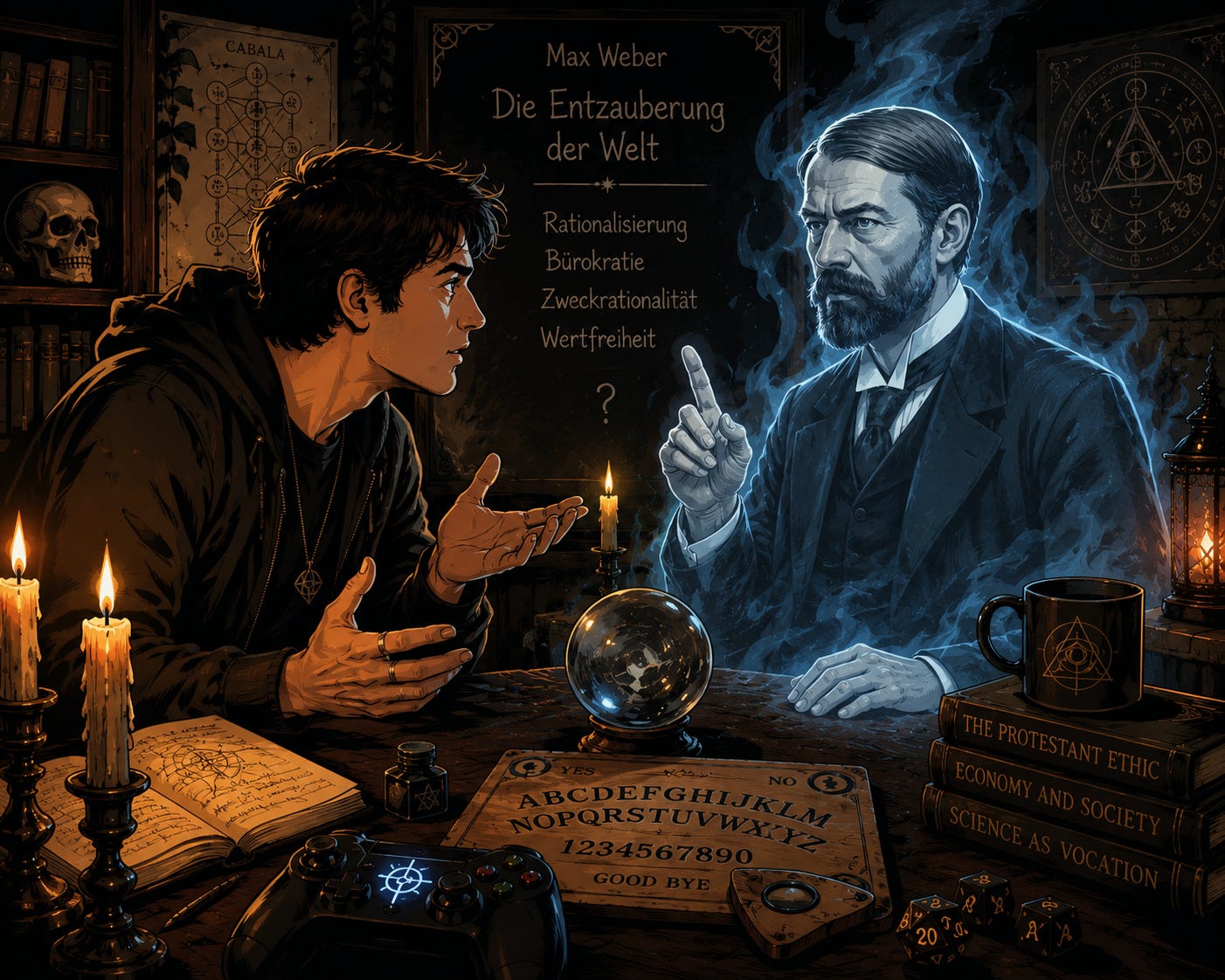
Well, I suppose now’s as good a time as any, so let’s summon the ghost of Max Weber for a séance that nobody asked for and nobody wants, but which I must conduct to appease the vengeful and spiteful spirits of rhetorical fairness and balance (a bit of an oxymoron, I know, but just play along).11
Weber, one of sociology’s founding fathers, argued that modernity’s defining spiritual event was Entzauberung — usually translated as “the disenchantment of the world,” though the German literally means something closer to de-magic-ing.
In his famous 1917 lecture “Science as a Vocation,” Weber attempted to diagnose our condition: for most of history, humanity lived in an enchanted cosmos, thick with spirits and teeming with mysterious, ineffable, and incalculable forces that had to be petitioned and appeased. Then, along came science and reason, which drained all the enchantment right out — not by explaining everything right off the bat (back then, there were many things that were still unexplained in the world, and hell, there still are to this very day), but by establishing that everything could in principle be explained, mastered, and calculated. Once reason planted its flag on society, there was no longer any room for magic. The collective zeitgeist wasn’t big enough to accommodate both science and spirits. From that point on, there would be no more mystery... just cold, rational mechanism, all the way down from top to bottom.
So now that we’ve invoked Weber’s ghost, let’s give it the floor, and let him make the strongest possible case against everything I’ve written today. A good Weberian might read this essay and say something like this:
*adjusts monocle*
“How charming. You’ve dolled up an ordinary rendering pipeline and dopamine loop vith fantasy and zuperstition and expect me to believe your little parlor trick. Zat “spell over ze audience” zat you talk up zo much is null but induced compulsion, ze same behavioral engineering zat compels gamblers to keep putting coins in a slot machine, which du yourself have written about vith appropriate horror.12 Your “performative language” bit is nothing more zan a lame pun on ze word “call,” and ze “wonder” zat you describe is a just an ordinary startle response enhanced vith ordinary (albeit very vizually impressif, I will give you zat) lighting effects. Zhis is not ze actual “re-enchantment” of ze world! Vat you describe is just a very profitable simulation of zat enchantment, and you only call it magic because ze word ‘magic’ flatters everyone involved in zis farce, from ze developers, to ze players, and especially ze newsletter writer who needs a grandiose capstone issue finished by Sonntag morgen.”
That is a good objection, Herr Doktor… and parts of it, I vill… er, will concede — and I’ll do so sincerely. No hedging. Well, not a lot of hedging, anyway.
First off… yes, “magic” has been working a lot of… erm… magic across this essay. I use the word in four distinct senses, which I’ve deliberately blurred together, and I really have connected them together, in some parts, primarily with wordplay. “Calling” a function uses the same verb as “calling” a spirit because engineers borrowed a metaphor, not because the compiler is literally haunted.
Now, I’ve argued that it’s meaningful that they borrowed this metaphor (as we’ve seen, vocabularies often migrate to areas that really do resemble their original functions). That said, a skeptic who dismisses the whole thing as just a “pun” is not entirely wrong, and not merely because it’s well-established by now that I’m a total sucker for a good pun (and the cringier, the better).
And I’d rather admit that than pretend that the four senses fuse into one seamless and all-explanatory Magical Theory of Everything, because they really don’t. But they do rhyme. And I argue that they rhyme too densely, and too frequently, to casually write the whole thing off as mere coincidence.
Second… no, not every game is a spell. Some games are just optimized retention curves and extractive engagement funnels with wizard hats and dragons in their capsule art and on their loading screens. Regular readers will recognize these as the frictionless free lich’s natural habitat: the cost-free (well, from the publisher’s vantage point, anyway) yet spiritually empty power fantasy.
The fact is, live service hamster wheels that dangle gems and Power Boosts behind an endless grind of daily logins and seasonal battle passes (or behind some in-game microtransaction store) are actually the exact opposite of enchantment! An ordinary game merely casts a spell on you (the way God intended) — it only wants you to believe in the spell it’s casting on (and for) you, literally a sacred exchange. Meanwhile, pay-to-win gamba slop (really, nothing more than a glorified Skinner Box with a rudimentary “game” grafted onto it) only wants you to spend, as much and as often as possible. In return, it will only give you stress, regret, debt, and a fanservicey anime waifu that the publisher will eventually yank away when it eventually unplugs the servers anyway.
So Weber’s notion of disenchantment actually applies quite well to games that miss the mark. It actually describes gaming’s worst instincts, almost uncannily perfectly. This industry builds both cathedrals and casinos, after all… and really, you’d have to be a fool to not instantly clock the distinction on first sight.
And finally, at no point in this essay do I ever prove the existence of anything supernatural… but then again, at no point do I even claim to! If you came here hoping I’d irrefutably and conclusively prove that spirits are real, then I don’t know what to tell you, bud. I’m sorry, but I have nothing to offer you but grief and disappointment… well, that and maybe a compiler or two (thanks for holding out for almost the entire essay, though!).
But now that Weber’s ghost has had his say, I get to plant my flag — because his framework contains one assumption I think is simply, utterly, and demonstrably false, and it’s actually the same false assumption behind the ubiquitous deflationary reading of Clarke’s famous quote:
The assumption is that understanding the mechanism dissolves the wonder.
But it simply doesn’t. It never has, and it never will. We literally just finished establishing this in Act III, but I suppose it bears repeating now that we have this pesky 19th Century German ghost in the room:
Every adult at every magic show knows there is an explanation and gasps anyway.
Why? Because wonder was never a function of ignorance! The wonder spawns from the gap between knowing and seeing, and good craft can in theory hold that gap open indefinitely. Weber assumed that there was a zero-sum tug-of-war between explanation and enchantment, but the entire history of stage magic refutes him, and games scale that refutation up to the tune of 3.5 billion participants worldwide.
And once that assumption falls, we can finally take a look at what “magic” actually was all along — not insofar as its supernatural claims (which were merely its proposed mechanism, and mostly unverifiable if not flat-out wrong), but the function underneath every tradition we’ve toured in this volume over the past three years: magic is a technology of will and wonder, a systematic practice for converting intention into worlds, and worlds into awe. That’s the magician’s job description that I compiled at the top of this essay… indeed, it was always the job!
And since we’ve also established that game developers are magicians, this means that the humble game dev also transmutes intention into awe. This is, indeed, the magus’ sacred duty, regardless of whether they wear a hood or a hoodie.
If you judge magic by how it supposedly works? Then yes, Weber won. The world is indeed disenchanted, and the spirits have left the building (or they never came in the first place), leaving us to toil and eventually die in a cold, mechanical, soulless cosmos.
But if you judge magic by what it actually does (and I’ll point out that magicians actually wrote grimoires in order to do things, not theorycraft)? Then a most remarkable thing happens… you start to see game development for what it really is. Magic, yes, but specifically, the only type of magic we know works.
We never lost the magic, dear reader. We simply shipped it; and now, it’s more potent than ever before.
Ok, now that we’ve firmly established and proven my thesis, let’s finally get rid of this pesky apparition. Auf wiedersehen, Doktor Weber!
Exorcizamus te, omnis immunde spiritus!
*The figure of Max Weber’s ghost vanishes into thin air*
The Word Was Inside the Word the Whole Time
Ok, we’re almost at the end of our time together, so let’s recap everything we’ve learned throughout the past ~2 hours (if you’re still with me, I truly thank you from the bottom of my soul for sticking around to the very end. Hang in there, we’re almost done!). Here’s the entire working, one last time:
The humble game developer speaks a world into being in a perfectly performative language consisting of true names, bound entities, grimoire libraries, and a cosmos sensitive to a single flawed character.
He then casts a spell, together with every wet-eyed gamer that’s ever picked up a controller. Each of these players agrees to enter a trance with him, as fragile as the chalk that lines the bounded circle he drew.
Plot twist: the player then turns out to be an apprentice holding a live wand. He chants words of power, borrows amulets, remixes the master’s grimoire, and finally rewrites the game’s laws from the inside. Apprentice and sorcerer become one.
And the whole apparatus is deliberately aimed, on a structural level, at manufacturing the gasp: Pledge, Turn, and Prestige, with “the craft” holding open “the gap.”
Every sense of magic that humanity ever conjured is on full display here… and all of it’s real, operative, and running inside every title in your Steam library.
And now, following Cutter’s admonition that making something vanish is worthless unless you bring it back, I now give you the restoration. Let’s bring back the very first thing I ever showed you in this volume: its own name.
AbraCODEabra
Cute pun, right? You know how much I love those. And, indeed, that’s what I thought when I first coined it, three years and 13 issues ago. But there’s a hidden layer to that pun… for “abracadabra”, the most famous magic word in the Western world, also happens to be one of the oldest we can actually date!
The incantation’s earliest documented appearance is in the Liber Medicinalis, a Roman medical poem from around the turn of the 3rd Century attributed to Serenus Sammonicus, a physician in the court of the Emperor Caracalla. It appears there as an ancient medical prescription: to cure a wasting fever, write ABRACADABRA on a piece of parchment, then write again beneath it but without a letter, then again, and again, and yet again, forming a triangle of shrinking text until the word dwindles to a single “A.” Then, hang the amulet around the patient’s neck, so that the disease shrinks and shrivels just as the word does.
Oh… will you look at that?! A word believed to do something (do, not describe) when correctly inscribed, to the exact character, in a particular format, its effect linked to its very spelling. Abracadabra is a performative utterance, some ~18 centuries before our good friend J.L. Austin gave us the term. It’s also the Golem’s emet, running in reverse: a string whose character-by-character deletion deletes its referent. But perhaps most importantly, it is also (in every sense we’ve established in this essay) a line of code: humanity’s oldest surviving one-liner, deployed to production on a linen thread.
And where does the word itself come from? Nobody knows! Truly, nobody; the trail goes cold before Sammonicus. But among all of the word’s contested origin stories, one in particular has become particularly beloved and unofficially canonized: that “abracadabra” derives from an Aramaic phrase, avra k’davra — “I create as I speak.”
I create as I speak.
If that legend holds true, even as poetry (and really, poetry is all that it needs to be), then the most famous magic word in our civilization is, at its root, a statement of creation-by-speech! The Book of Genesis, in just three syllables. Ptah’s heart and tongue, compressed into chantable form. This +20,000-word essay’s entire argument has already been folded into the incantation your great-great-grandmother used to say over card tricks!
This Volume has been incanting its own thesis since the very day it launched, right under our very noses! And wait, I’m not done yet, for there’s still yet another layer to all of this: I named it AbraCODEabra for the pun, and the pun itself housed the literal magic! Here we have the world’s oldest magic word, the one that literally means “I create as I speak,” and just look at what’s been sitting right there in the middle of it all along, hiding in plain sight (just like the best magic tricks always do):
Abra-CODE-abra.
I create as I speak… in CODE.
The word was inside the word, all along! My friend, you thought you were just reading a newsletter about magic in video games… but you were actually holding the entire grimoire in your very hands, all this time! And every evening you’ve ever spent resting at a save point inside a Secondary World, aweing at the painted mountains on the horizon and crying for the dead NPC who never actually existed but whom you chose to grieve anyway? You stood within a magical working, inside a magic circle that you helped a professional magus draw.
So to wrap up this volume, I now give you your final quest… and don’t worry, it might well be the easiest one you’ve ever embarked upon: go step into a magic circle. Boot up a game tonight! Cross the threshold into a whole new world at the title screen, now that you know that it’s actually consecrated ground that an IRL magician spoke into being solely to enchant you in the best possible way, which only works because you choose to believe in it (but keep one candle burning, my apprentice, because a brand-new Bonus Quest will drop sometime in the next week or two. In it, we’ll dive into the wild and wacky world of technomancy, where we’ll meet the real people doing real magic with motherboards and GPUs… trust me, you’re gonna need the salt handy!).
I create as I speak…
And so does everyone who ever made a world for you and me to get lost in.
As above, so below.
Avra k’davra,
~Jay
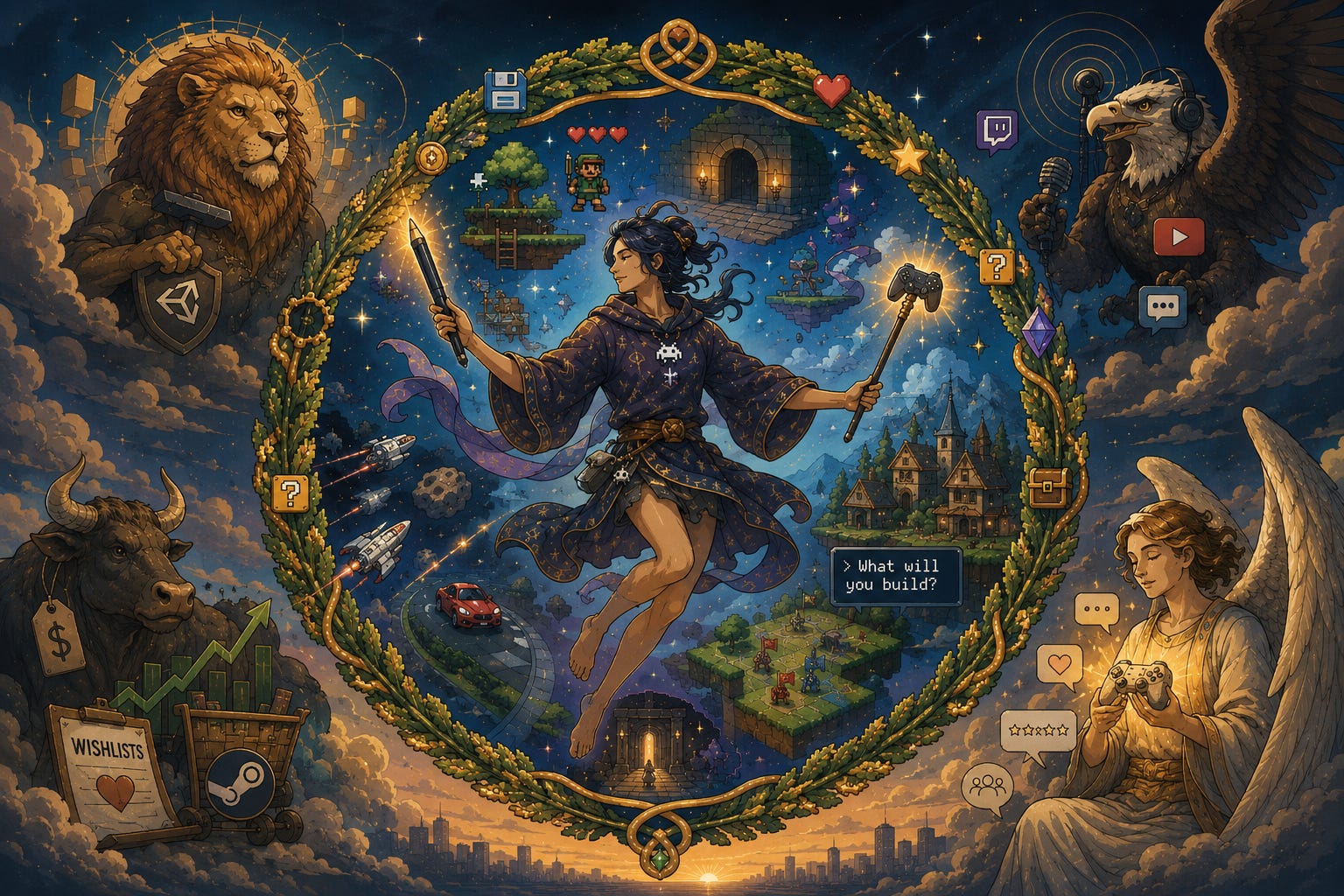
Food for Talk: Discussion Prompts
Alright, you made it through the whole thing! Now it’s your turn. While you wait for the next issue, I invite you to mull over the following discussion prompts. Please reply to this email with your answers, or post them in the comments. I'd love to hear your thoughts!
Of the four senses or aspects of magic we covered this week (Creation, Enchantment, the Apprentice’s wand, and Wonder), which one resonated the most with you? And which one are you still side-eyeing? (Be honest, this is a safe comment section! Also, Weber’s ghost could use some company.)
Have you ever cried over a person who doesn’t exist? Tell me about the moment a game most inflicted the feels on you… and now that you know that it was a spell you helped cast on yourself, does that make the memory feel more meaningful, or less?
Where do you draw the line in the apprentice writing the master’s grimoire? Are cheat codes fair play, but mods heretical? Is glitching a form of sacrilege against the game developer’s world, or the highest honor you can pay it? And do you think speedrunning’s “glitchless” categories are a form of reasonable rule enforcement, or just the priesthood building another arbitrary fence?
The Weber Test (Patent Pending): has learning how a magic or game dev trick works ever killed the wonder for you? Conversely, what’s something (whether in games or otherwise) that actually got MORE wondrous once you understood how it worked?
Developers and modders: do you feel like a magician when you build these things? Or does it all feel considerably less mystical when you’re two months into crunch?
If you had access to a perfectly performative language (as in: say it right, and BOOM it happens), what’s the very first spell you’d cast? (If you say “infinite lives,” I’ll fail you unless you also tell me what you’d do with all those lives.)
Further Reading
Books
Tolkien On Fairy-Stories by J.R.R. Tolkien (expanded edition, eds. Verlyn Flieger & Douglas A. Anderson) — The Professor’s 1947 essay in full: covers the concepts of sub-creation, Secondary Worlds, and Secondary Belief, all straight from the source himself, along with bonus scholarly commentary that traces how these ideas evolved. A must-read for anyone who makes worlds… or simply loves to get lost in them. [Amazon]
How to Do Things with Words by J.L. Austin — The 1962 lectures that gave us the concept of performative utterances, as well as (accidentally) the operating manual for every incantation in history. Fair warning: this can be drier than the Caelid wastes in places, but the core idea is one of the greatest paradigm shifts in 20th Century philosophy that you never heard of until today. [Amazon]
TechGnosis: Myth, Magic, and Mysticism in the Age of Information by Erik Davis — Making its second Volume 5 appearance (we first summoned it back in Issue 5.1), and for good reason; it’s more than earned both appearances. This is the definitive account of how our collective occult imagination survived the Enlightenment, by simply getting a job in tech. If this issue lit you up, make this your next read. [Amazon]
Homo Ludens: A Study of the Play-Element in Culture by Johan Huizinga — Yes, this was in Issue 5.11’s list too. Again, for good reason: it’s the foundational text of game studies AND the source of the magic circle, therefore I get to cite it twice in these pages. This text first identified the concepts of play being older than culture, as well as the play-ground as consecrated space. [Amazon]
Rules of Play: Game Design Fundamentals by Katie Salen & Eric Zimmerman — This 2003 tome promoted one of Johan Huizinga’s passing phrases into game design’s current term of art. Absolutely massive, not to mention canonical for any game developer, this work is surprisingly readable for a textbook you could literally use as a doorstop. [Amazon]
Flow: The Psychology of Optimal Experience by Mihaly Csikszentmihalyi — The classic study of the trance state you enter when you’re 40 hours into an RPG, written by the psychologist who named it. Read it, and you’ll never think of or experience “just one more turn” in quite the same way again. [Amazon]
Liber Null & Psychonaut by Peter J. Carroll — Chaos magic’s founding manual: this book introduced the idea of belief as a tool, sigils as psychological technology, and the whole paradigm of magic as a way to hack your mind… all in its rawest form. You can approach this book as anthropology, practice, or both… dealer’s choice, and belief or disbelief (as always) rests with you. [Amazon]
The Red Book (Liber Novus) by C.G. Jung — Here it is… His Luminousness the Prophet Carl Jung’s visionary self-experiments, published a century after he first conducted them: his pioneering methodology of active imagination, rendered as modern-day scripture and first-person travelogue, and gorgeously illustrated by the man himself. The deluxe edition (if you can locate a copy) is a legitimate grimoire, whereas the Reader’s Edition is a more practical buy. (And if raw Jung is too deep of an an opening dive, Man and His Symbols remains an accessible on-ramp, which we’ve recommended since the halcyon days of Volume 3.) [Amazon]
Web & Video
The Prestige (2006), dir. Christopher Nolan — The finest primer on stage magic ever smuggled into a mainstream film, and the source of this issue’s Pledge/Turn/Prestige framework. Watch it cold if you somehow haven’t already. And then watch it again immediately, because the movie is itself the very trick it describes. — [Hulu]
The Mindscape of Alan Moore (2003) — The bearded wizard of Northampton explains, at length and with total sincerity, why art is magic and writers are literal sorcerers. Whether you think he’s a visionary or just gloriously unhinged (the correct answer is “yes”), this masterpiece nevertheless remains the definitive thesis on psychological magic, as argued by its most famous living practitioner. — [Shadowsnake Films]
SNES Code Injection — Flappy Bird in SMW by SethBling (YouTube) — Watch a human being manually reprogram Super Mario World into Flappy Bird using nothing but stock controllers, in front of a live audience, while fully explaining the working. This is the single best document of the most forbidden art in action, and a truly gripping watch… even if you can’t tell a hex value from a hexagram:
Super Mario World: Arbitrary Code Injection at AGDQ 2014 (YouTube) — And now, the historic public debut: TASBot conjuring Pong and Snake inside a running Super Mario World on real hardware, also in front of a live audience, through nothing but the controller ports. Behold, the moment the apprentice openly mogged and became the sorcerer:
Lewis Galoob Toys, Inc. v. Nintendo of America, Inc. — The full saga of that fateful day when the hedge witch defeated the church in open court. Grab a cuppa and sit down with this surprisingly readable summary of the case that established your legal right to enchant your own cartridges. [Wikipedia]
Newzoo Global Games Market Report — This is the industry-standard annual census of the global games industry (aka the 21st Century’s global wonder trade). It covers revenue, player counts, and platform breakdowns, and the fine folks at Newzoo update it each year. You can even access a free edition! So if anyone ever tells you that video games aren’t a “real” industry, show them this report then watch them yank the goalposts and dash away. [Newzoo]
Games Featured
[ED NOTE: Sorry, folks, but apparently, Pangram thinks this section is AI, even though I’ve structured it like this for years now, long before generative AI was even a thing (never mind it actually being able to write somewhat competently)… but nevermind that, the AI detector with a “0.01% false positive rate” has rendered its decree, and so I must acceed to its judgment.
So, here’s a screenshot instead. Yeah, I know, it’s not nearly as useful without clickable purchase links, but it was either this or taking it out altogether. This is their platform now, we’re just creating data posting in it. If you want a good laugh/cry, click to see the scan results for yourself.]
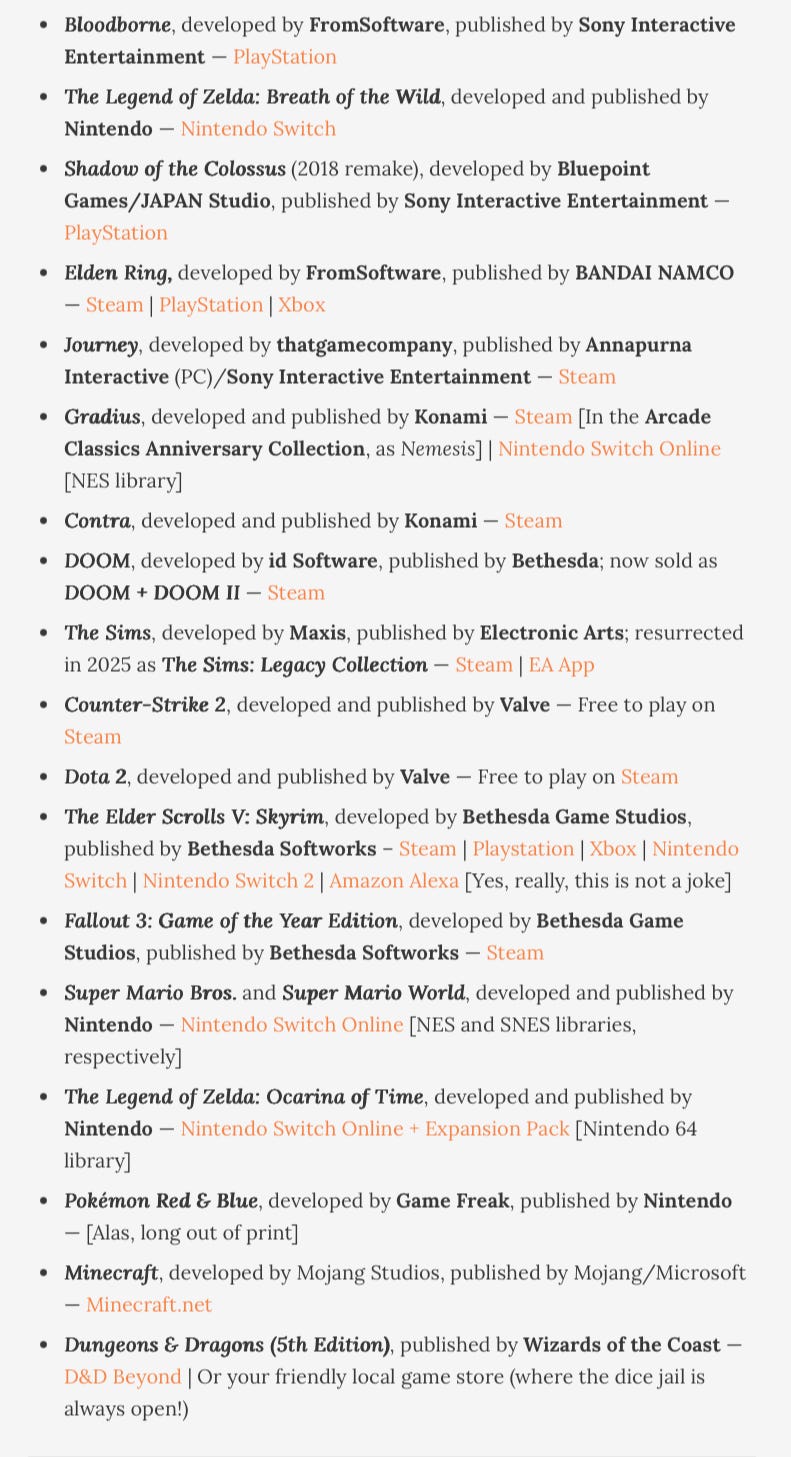
[ED NOTE: Apparently, this section is also “AI,” even though I’ve worded this particular boilerplate like this since almost the very start of this newsletter. So here’s another screenshot… though I doubt a lot of folks read this part anyway.]
Tags
#philosophy #metaphysics #religion #spirituality #narrative #magic #psychology
#AbraCodeAbra
#zelda #shadowofthecollossus #eldenring #journey #gradius #contra #doom #thesims #counterstrike2 #dota2 #skyrim #fallout3 #supermariobros #supermarioworld #ocarinaoftime #breathofthewild #pokemon #minecraft #dungeonsanddragons
Footnotes
Yes, that is a very old internet reference. No, I will not be elaborating. If you know, you know… but if you don’t, then for the love of all that is good and holy, DO NOT look it up on a work computer.
And in an ironic twist, which every developer who’s ever seen their documentation get deprecated will feel in their very bones, the Shabaka Stone was later repurposed as a millstone, with a big ole’ hole ground right through the middle of its sacred text! So if you’ve ever seen your hard work suddenly become utterly irrelevant from one day to the next, take solace in the fact that even divine specs sometimes get overwritten by someone who needed the disk space.
I did not plant it two years ago. Believe it or not, I’m not that smart. But I am smart enough to notice a loose thread when I’ve left one dangling, which is roughly 40% of this newsletter’s whole editorial strategy.
Another dangling thread. Told you: 40%.
I’m being generous here. By empirical standards, the evidence is only slightly less believable than your uncle’s unhinged Facebook posts. But that’s almost besides the point — what matters is that the aspiration itself was not only real, but literally universal to all humankind. Consider what this reveals about what we’ve always wanted language to be.
Pointers and undefined behavior enthusiasts, I can hear you starting to hyperventilate, so let me bring you back from the edge real quick. Yes, I know that C exists. But that actually proves my point! C is what happens when you let the demon negotiate the terms of its binding. Which is why the elders gave us memory-safe languages! And we ignore the elders at our peril.
So don’t try to “gotcha” me in the comments with “dUrRrR bUt tHe dEvElOpEr dOeSn’T wEaR a hOoD!!1!” — that isn’t the point, genius. And in any case, the dev does wear a hoodie, and you can’t spell “hoodie” without “HOOD,” ever thought of that?!
Meanwhile, another priesthood competes to run DOOM (1993) run on literally everything they can get their hands on. So far, they’ve done it with calculators, ATMs, GPS devices, oscilloscopes, pregnancy tests, and even a gloriously insane rig that they powered with 100lbs of potatoes. The old grimoires may have promised to make clay come to life, but we chose to do it with root vegetables instead. And of course we made them run DOOM.
In fact, people who work in game AI express no shortage of irritation towards anti-AI zealots who constantly lump them in with generative AI, even though the former predates the latter all the way back to literally the start of video games.
Ex-Bethesda devs have lovingly debated and clarified the precise anatomical details over the years (for instance, by some accounts, the train was worn on the arm rather than as the “train hat” that seems to have become the accepted folklore), but regardless, the sheer absurdity of it all remains intact: the train is literal clothing. Somewhere under that game world, some NPC is dressed as public transit, and you never once suspected a damn thing! If that’s not stagecraft, then the word officially has no meaning.
Actually, it’s just the commenters who’d “well, actually…!!!” me if I don’t try and play this at least somewhat even-handedly.